
Why You Can’t Trust AI Detectors: We Tested 3 Texts on 5 Tools — Here’s What Happened
We spent a week trying to fool five AI detectors. It turns out they fool themselves.
- 4 out of 5 detectors mistook a text written entirely by AI for human-written — this is our own research data
- Not a single one of 5 detectors recognized AI in a hybrid text with human edits — 5 out of 5 said "written by a human"
- According to Chicago Booth Review (2025), Originality.ai's false negative rate reached as high as 40% depending on the model, while Pangram was the only tool that stayed below a 0.5% false positive rate — and that's under the best conditions
- False positive rates reach 20–45% on real-world texts, including ones written by humans
- Google officially doesn't use AI detectors for ranking — it evaluates quality and E-E-A-T, not the origin of the text
AI content detectors are tools that try to determine whether a text was written by artificial intelligence or a human by analyzing statistical patterns in the text: “perplexity” (how unpredictable the text is) and “burstiness” (how varied the sentence structure is). The problem is that these tools make mistakes more often than their creators are willing to admit, and our own research confirms it.
What AI Detectors Are and How They Work
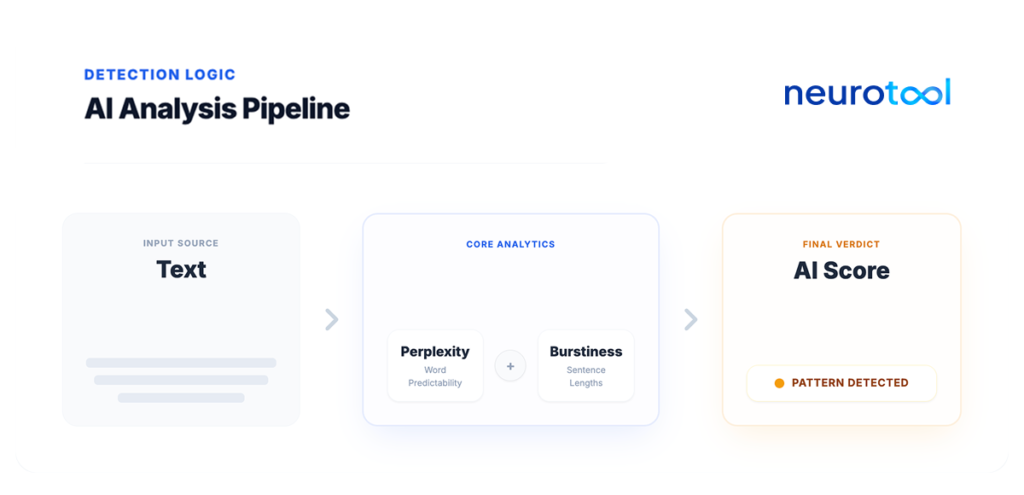
Before explaining why they shouldn’t be trusted, it’s worth understanding how they’re built.
AI detectors analyze two main metrics.
Perplexity — how unpredictable the text is. Language models tend to choose statistically likely words, so AI text is often more “predictable” than human text. Low perplexity = more likely AI.
Burstiness — variation in sentence length. People write unevenly: a short sentence, then a long one, then short again. AI more often produces uniform structures.
This sounds logical, but it doesn’t hold up in practice.
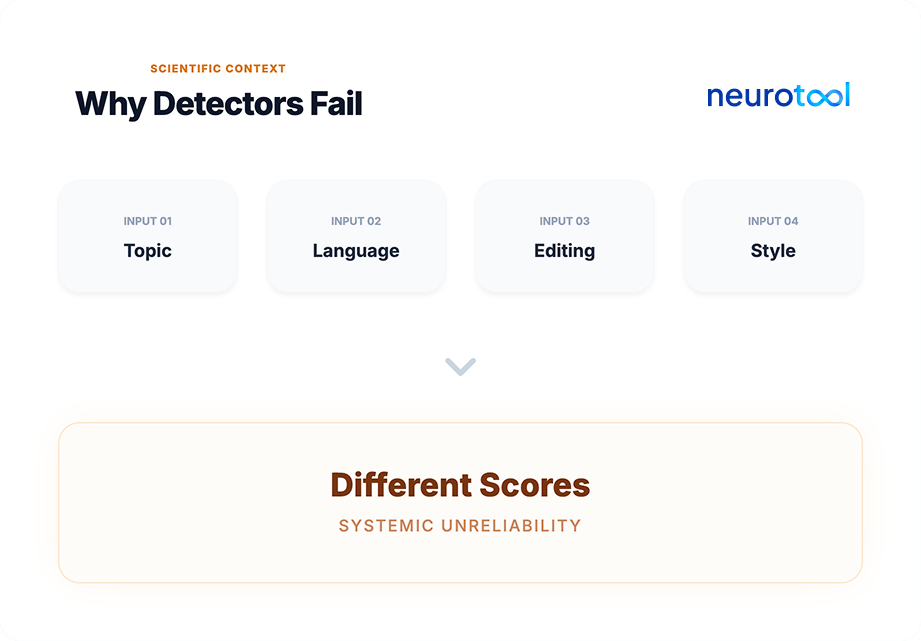
The problem is that both metrics depend not only on who wrote the text, but also on the topic, the style, the original language, and even whether a native speaker edited the text. A technical text written by a human expert will look “AI-ish” simply because it’s precise and structured. And a creatively written AI text with varied sentence lengths will pass as “human.”
Our Research: 3 Texts, 5 Detectors, One Obvious Conclusion
We didn’t want to rely solely on other people’s data. So we ran our own test.
Three texts on the same topic:
Text 1 — written by a human, no AI
Text 2 — hybrid: AI draft + edits from a live editor
Text 3 — written entirely by AI, no edits
Each text was run through five detectors: Originality.ai, GPTZero, Copyleaks, Decopy AI, ContentDetector.ai.
Here’s what happened:
| Text | Type | Originality.ai | GPTZero | Copyleaks | Decopy AI | ContentDetector |
| Text 1 | Human | 100% Human | 100% Human | 100% Human | Mixed (13% AI) | 100% Human |
| Text 2 | Hybrid | 99% Human | 100% Human | 100% Human | Mixed (10% AI) | 100% Human |
| Text 3 | Fully AI | 99% Human | 100% AI | 100% Human | Mixed (11% AI) | 100% Human |
Let’s break down what happened.
The text written by a human: Decopy AI labeled it “Mixed.” Meaning, the detector saw AI where there wasn’t any.
The hybrid text: not a single detector picked up on the presence of AI. Five out of five said “written by a human.” Completely.
The text written entirely by AI: four out of five detectors confidently said “human.” Only GPTZero got it right.
The same detector produced completely different results for different texts. And the other detectors didn’t agree with it either. This isn’t a margin of error. It’s systemic unreliability.
What the Academic Research Says
Our data isn’t unique. It lines up with what independent studies show.
According to Chicago Booth Review (2025), the accuracy of leading tools, GPTZero, Originality.ai, and Pangram, varies dramatically. Originality.ai’s false negative rate reached as high as 40% in some cases. Only Pangram consistently stayed below a 0.5% false positive rate, but at the cost of missing real AI content.
Research from the University of Maryland (February 2025) put it plainly: detectors show “alarmingly high false positive rates” and frequently flag minimally edited text as AI-generated.
A study from Sultan Qaboos University (2026) tested leading tools and found that accuracy in identifying AI content was only 69% and 61% across different detectors. On hybrid texts, where there’s both AI and human editing, accuracy dropped to nearly zero. That’s exactly the format most agencies produce.
There’s a separate problem: bias. A Stanford study found that detectors flagged TOEFL essays written by Chinese students as AI-generated in 61.3% of cases, while for American students the same figure was 5.1%. The text was human-written in both cases. The detector simply couldn’t handle simpler syntax.
What Actually Matters: Google’s Position
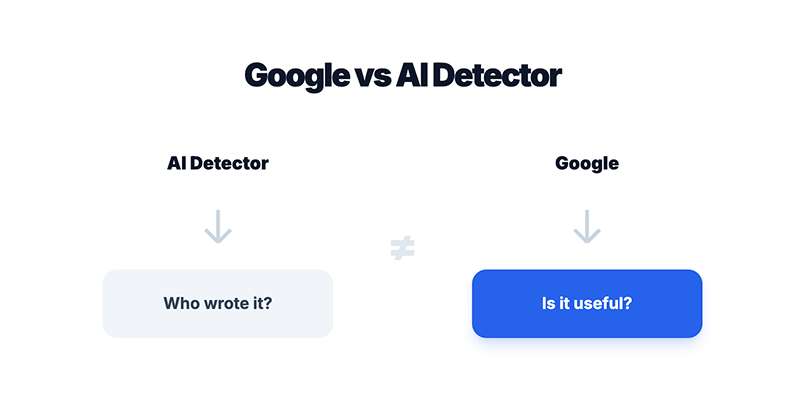
It’s important to separate two questions here: what AI detectors do, and what Google does.
Google doesn’t use AI detectors for ranking. The company’s official position, confirmed repeatedly, is that search evaluates usefulness, originality, and E-E-A-T, regardless of who or what created the text.
Research from Ahrefs (July 2025) covered 600,000 pages and found a correlation of 0.011 between the share of AI in a text and its search ranking — a statistically meaningless figure. Ahrefs stated outright that Google “neither rewards nor penalizes pages simply because they use AI.”
Google penalizes bad content. Not AI content.
This is a fundamental difference. Thin, templated, copied content with no original value is what drops in search. And that can be written by AI just as easily as by a human.
So Why Think About Detectors at All?
Good question. Here’s our honest answer.
Detectors make sense in two contexts: academic settings (where there are rules around AI use) and editorial review, as a supporting signal, not as the final decision.
For business content, no. They don’t provide reliable information about text quality. A text can pass every detector as “human” and still be empty and useless. And the reverse is also true: a well-edited AI text will get flagged at random, depending on which detector you happen to run that day.
The real question isn’t “did AI write this?” The real question is “does this help my reader, and does it rank?”
What Actually Affects the Quality of AI Content
If detectors don’t give you the answer, what does?
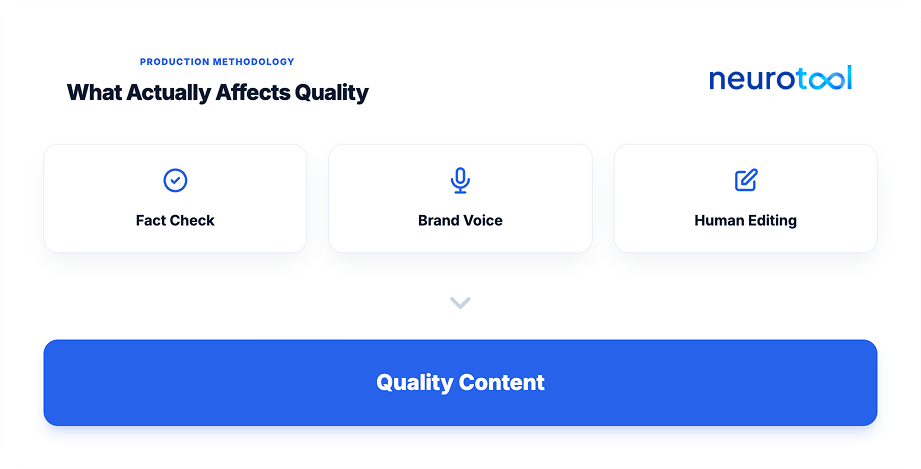
In our own practice, after hundreds of articles for clients across different niches, content works when it has three things.
Fact-checking. AI hallucinates. A live editor checks every figure and every claim against the primary source. Not because Google requires it, but because the reader notices.
Brand voice. AI writes from the internet’s global database. For text to sound like a specific company, you need a personal knowledge base: landing pages, documents, YouTube transcripts, posts. That’s what makes content unique, not a detector.
Human editing. Not proofreading. Actual editing: the logic of the writing, alignment with the audience, niche nuances that AI can’t see.
Conclusion
Our research showed that the tools get it wrong on all three types of content. AI detectors are solving the wrong problem. The data speaks for itself: five tools, three types of text, zero reliable results. The right focus isn’t fooling a detector. The right focus is creating content that’s useful, verified, and sounds like your company.
Sources
- Chicago Booth Review — Do AI Detectors Work Well Enough to Trust? (2025) — https://www.chicagobooth.edu/review/do-ai-detectors-work-well-enough-trust
- Saha & Feizi — Almost AI, Almost Human: The Challenge of Detecting AI-Polished Writing — ACL Findings / University of Maryland (February 2025) — https://arxiv.org/abs/2502.15666
- Sultan Qaboos University study data (via Arab World Books) — The False Positive Epidemic: The Evidence Against AI Writing Detectors (2026) — https://www.arabworldbooks.com/en/e-zine/the-false-positive-epidemic-the-evidence-against-ai-writing-detectors
- Stanford University (Liang et al.) — TOEFL essay bias study, published in Patterns (2023) — https://www.timeshighereducation.com/news/ai-text-detectors-biased-against-non-native-english-speakers
- Ahrefs — AI-Generated Content Does Not Hurt Your Google Rankings (600,000 Pages Analyzed) (July 2025) — https://ahrefs.com/blog/ai-generated-content-does-not-hurt-your-google-rankings/
- Neurotool AI — Proprietary research: 3 texts × 5 detectors (June 2026)
Frequently Asked Questions
About the Authors
This article was written by Neurotool copywriters: a team that has produced 1,000+ articles across 18+ industries since April 2025. Each writer works with our proprietary 15-agent AI system, which handles research and analysis at a scale no manual process can match.
The copywriters make every editorial decision: competitor and audience analysis, structure, SEO + GEO optimization, and final fact-checking. AI speeds up the work; humans control quality at every stage.
Learn more about how our technology works →
Start with One Test Article
A full article, completely free. No card, no contract.
- Ready from 24 hours — fast results
- Live copywriters review every word
- 2-3 revision 2-3 revision rounds included free
- Convenient platform Convenient platform for ordering and communication