
Fact-Checking Every AI-Written Article: How We Do It — and Why It’s Still Rare in 2026
AI makes up facts. Most agencies don't check for it. Your content is at risk.
- AI models invent nonexistent sources in up to 94% of cases under adversarial testing — and sound completely confident while doing it
- Stanford Research recorded a 58–88% hallucination rate in legal queries put to leading language models
- In 2024, businesses lost $67.4 billion because of decisions made based on AI hallucinations
- 86.5% of pages ranking on Google's first page contain AI content — but only fact-checked content holds that position for months
- Content with verified facts and sources is 89% more likely to be featured in Google AI Overviews — a direct GEO outcome
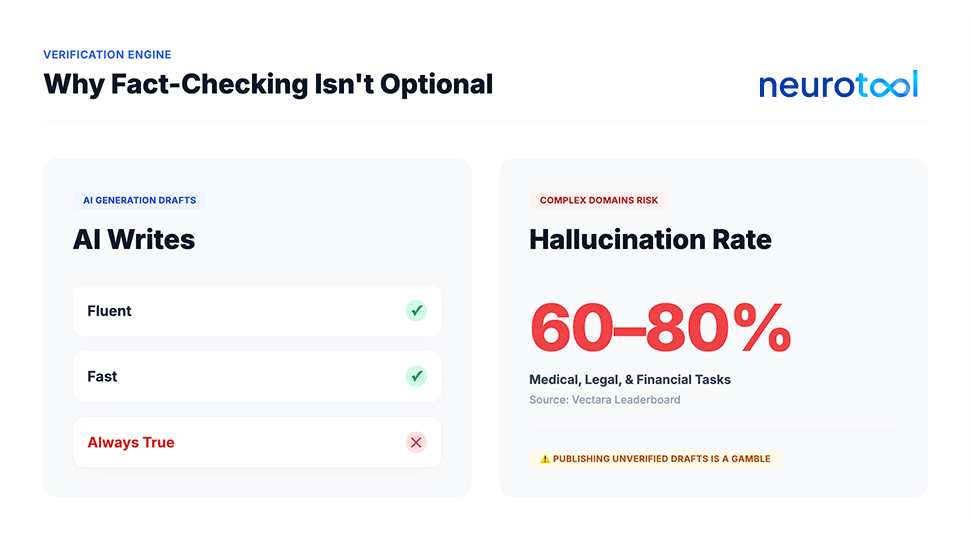
AI content fact-checking is a structured process of verifying every claim, figure, and source in a text before it’s published. In 2026, when language models generate content with the confidence of a professor and the accuracy of a random passerby, publishing an AI article without this kind of check is a gamble. According to the Vectara Leaderboard 2025, even the best models make mistakes, and on complex tasks — medical, legal, financial — the hallucination rate reaches 60–80%. That’s exactly why fact-checking isn’t optional. It’s an obligation.
July 2025: Deloitte Hands the Government a Report With Fabricated Judges
The Australian government paid Deloitte $290,000 for an audit report on its welfare benefits system. 237 pages. Big Four. Serious work.
Dr. Chris Rudge of the University of Sydney opened the document a few weeks after publication. Something immediately seemed off. He started checking the sources — and couldn’t find a single one. The report contained more than 20 errors: references to nonexistent studies, quotes from a federal judge who didn’t exist, academic papers from universities that never published them. Deloitte returned part of its fee and reissued the report with a disclaimer about its use of Azure OpenAI GPT-4o.
The story could have ended there. But a month later — Canada.
The province of Newfoundland and Labrador paid the same Deloitte $1.6 million for a healthcare report. The same story: AI-generated errors, nonexistent sources. The second case in a year. The second country. One contractor.
This isn’t a story about Deloitte being a bad company. It’s a story about hallucinations happening to anyone who uses AI without systematic fact-checking. Even the largest consulting firm in the world.
Why AI Lies Confidently — and What Can Actually Be Done About It
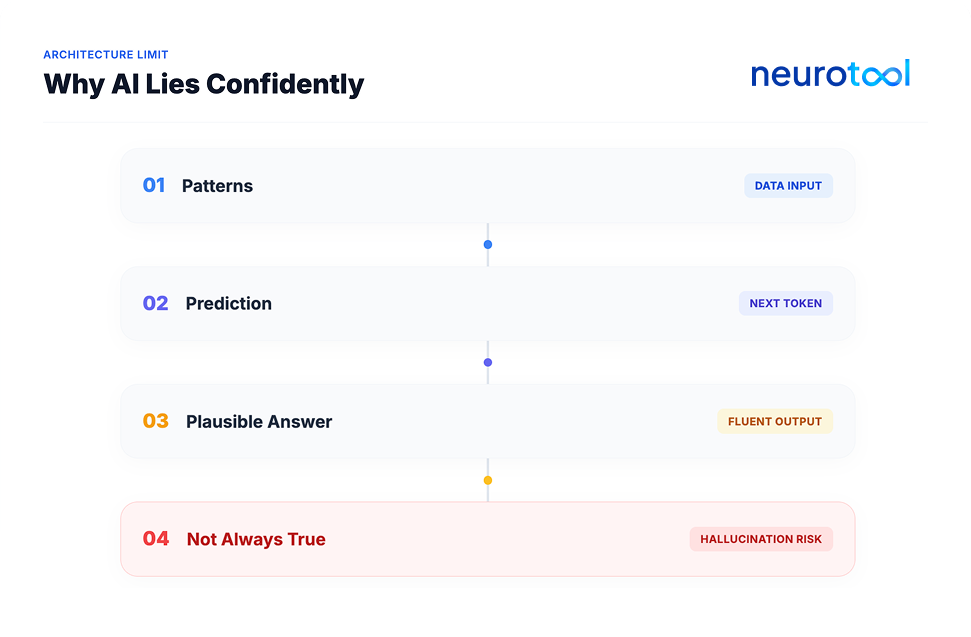
Here’s a question that seems obvious: why doesn’t the neural network just say “I don’t know”?
Most people assume AI makes mistakes because it isn’t smart enough. The reality is the opposite. A language model predicts the next token based on statistical patterns. It doesn’t “know” facts — it reproduces whatever sounds plausible in a given context. And that’s exactly why the errors don’t look like errors: they’re formatted correctly, with quotation marks, with references to real publications — the data just isn’t actually there.
This is called hallucination. And it can’t be cured with a “smart prompt.”
We’ve confirmed this through our own experience: you can write “never make up statistics” in a prompt, and the model will still sometimes do it anyway. Not out of malice. Simply because architecturally, it’s built differently from a search engine.
According to SQ Magazine (April 2026), Stanford Research recorded a hallucination rate of 58% to 88% in legal queries put to leading LLMs. Picture this: in every second or third statement about the law, the neural network might produce something that doesn’t exist. And it does so confidently, with correctly formatted quotation marks, citing a real court.
The good news: this doesn’t mean AI content can’t be published. It means there needs to be a process between generation and publication. A specific one. A reproducible one. A mandatory one.
Fact-Checking and Editing Are Not the Same Thing
Here’s a mistake we see constantly.
An agency says, “we have an editor who checks everything.” The editor reads the text, polishes the style, removes repetition, checks the structure. The text sounds good. It gets published.
A month later, it turns out one of the key quotes in the article links to a study that doesn’t exist.
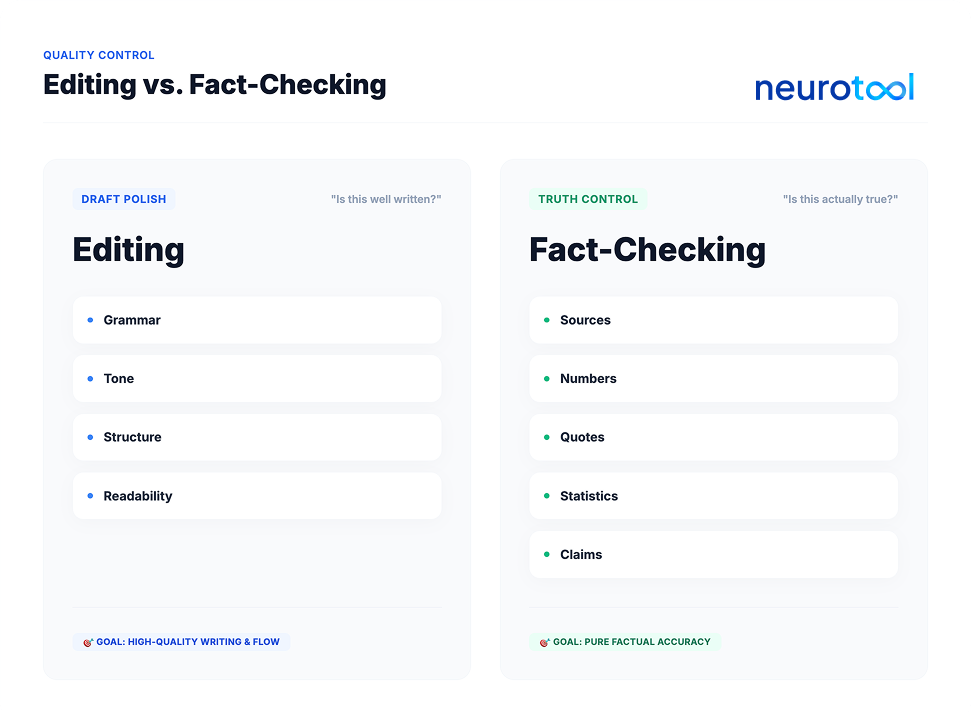
Editing answers the question: is this well written? Fact-checking answers the question: is this true?
You can write a perfectly structured, readable, “lively” text — and it can still contain fabricated statistics. An AI detector won’t catch it. Neither will a plagiarism checker. Because from a style standpoint, everything checks out clean.
Here’s what must be verified, no compromises:
Mandatory to verify:
- Any figure, percentage, or statistic
- Study names, publication year, authors
- Quotes and statements attributed to anyone
- Legal standards, regulations, legislative references
- Medical claims and clinical data
- Cause-and-effect relationships (“X led to Y”)
Edit, but don’t need to verify:
- Tone and voice
- Examples and analogies
- Narrative structure
- Transitions between paragraphs
If an editor reads the text and decides it “sounds good,” that’s proofreading. It’s necessary. But it’s not fact-checking.
Our Three-Layer Process: What Happens to Every Article Before Delivery
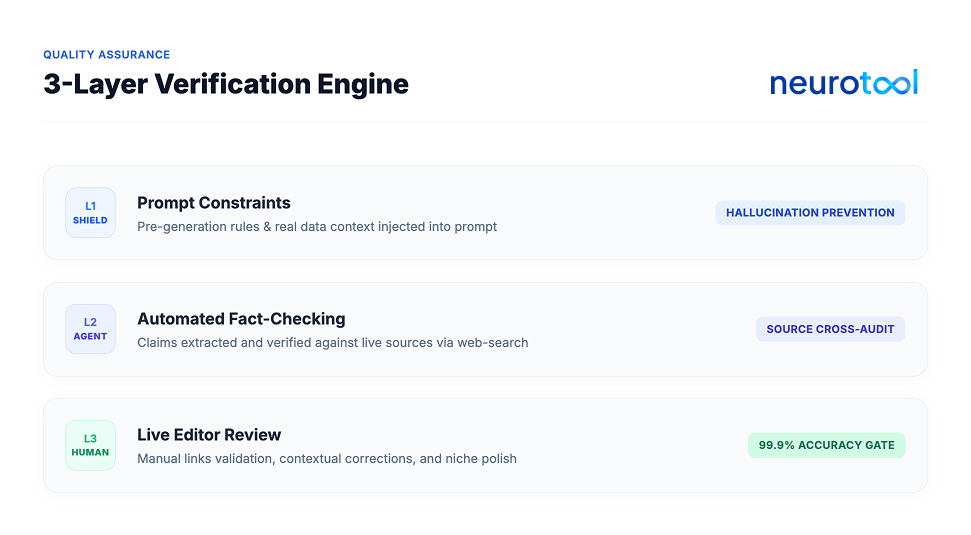
We don’t fact-check “when we feel like it.” It’s built into the production process — three independent layers every article passes through before it reaches the client.
Layer 1 — Control before the first word
Before the neural network starts writing, hard constraints are already built into the prompt. The model receives an explicit prohibition: don’t use statistics without a source, don’t make up studies, don’t cite figures that can’t be verified.
But a prohibition alone isn’t enough. For every article, we conduct preliminary research and load real data from verified sources into the context. The model works with concrete facts instead of filling in gaps from its own patterns.
This lowers the hallucination rate at the input stage, before the text even exists. It’s the baseline.
Layer 2 — Automated fact-check agent
Once the article is written, it goes through verification.
A specialized agent goes through the text, extracts every verifiable claim, and checks each one via web search and web fetch: it finds the primary source, opens the page, and cross-checks the data. The result is a structured report:
FACT-CHECK SUMMARY:
✅ Confirmed facts:
— [Fact]: verified via [Source + URL]
⚠️ Unconfirmed claims:
— [Claim]: source not found → removed / rewritten
❌ Corrected errors:
— [Original claim] → [Corrected version] (Source: URL)
CONCLUSION: Article [READY FOR PUBLICATION / NEEDS REVISION]
No article moves forward until the report says “READY.”
Layer 3 — A live editor
The final layer. A human.
The editor reads the article with the fact-check report in front of them. Their job isn’t “does this sound good” — it’s specific questions: do all the links lead to real pages? Are there contextual errors, where a fact is real but applied incorrectly? Are there niche-specific nuances the AI might have missed?
At one extreme is a content factory that generates 200 articles a day and never opens a single link manually. At the other is a boutique agency with a specialized expert editor for every niche, charging $300 per article. We sit in between: automated fact-checking at layer 2, live context verification at layer 3. That combination is what produces the result.
According to MindStudio, organizations with human-in-the-loop processes achieve accuracy of up to 99.9% in document-based work — versus 92% for fully automated systems. A 7.9 percentage point difference might sound small. Across 100 articles a month, that’s 8 potentially problematic pieces.
Stop manually fact-checking someone else’s work. Neurotool AI delivers finished SEO articles in 24–72 hours — with fact-checking built in. Learn more →
Not All Errors Cost the Same
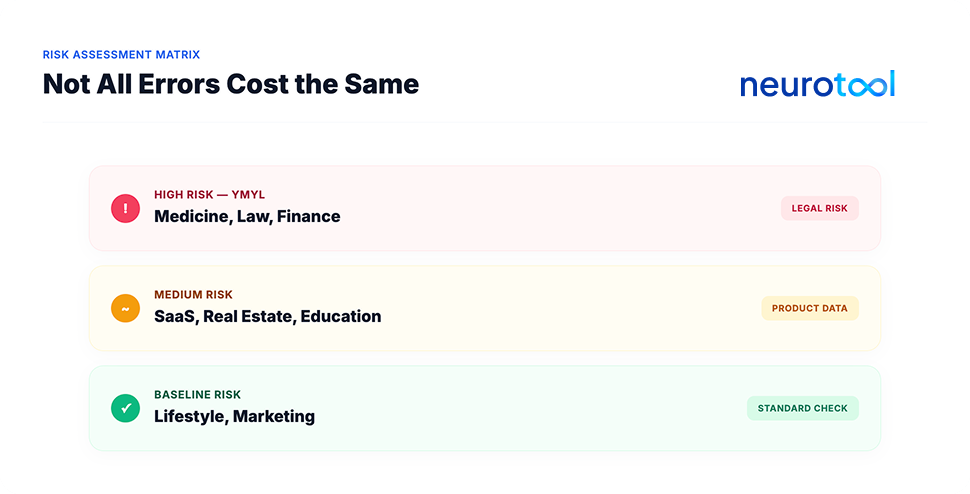
If a food blog says turmeric “reduces inflammation” without a source, the reader shrugs it off. If the same claim appears in an article for a medical clinic about treating arthritis, that’s now a legal and reputational risk.
We use a three-tier niche classification. Not because it’s more convenient for us, but because applying one protocol to every niche is either overkill or negligence.
🔴 High risk — YMYL topics
YMYL (Your Money or Your Life) is Google’s category for topics where errors affect a person’s health, finances, or legal standing.
Medicine: every claim is checked against PubMed, UpToDate, or official medical resources. Disclaimers are mandatory. An error here is a legal and reputational risk for the client.
Law: jurisdiction matters. What’s true in Germany may not be true in Spain. AI doesn’t think about that. A human editor does.
Finance: regulatory changes happen fast. Tax rules, SEC/FCA/BaFin requirements — all of it requires verification against official government sources.
🟡 Medium risk
SaaS, e-commerce, real estate, education. The main danger is outdated product data, incorrect competitor comparisons, fabricated case studies.
🟢 Baseline risk
Lifestyle content, marketing copy without technical claims. Standard fact-checking covers it.
And here’s what surprised us when we systematized this: most agencies that say “we do fact-checking” apply a baseline protocol to every niche without distinction. For lifestyle content, that’s fine. For a medical client, it isn’t.
Fact-Checking Isn’t Just About Honesty. It’s About Search Rankings.
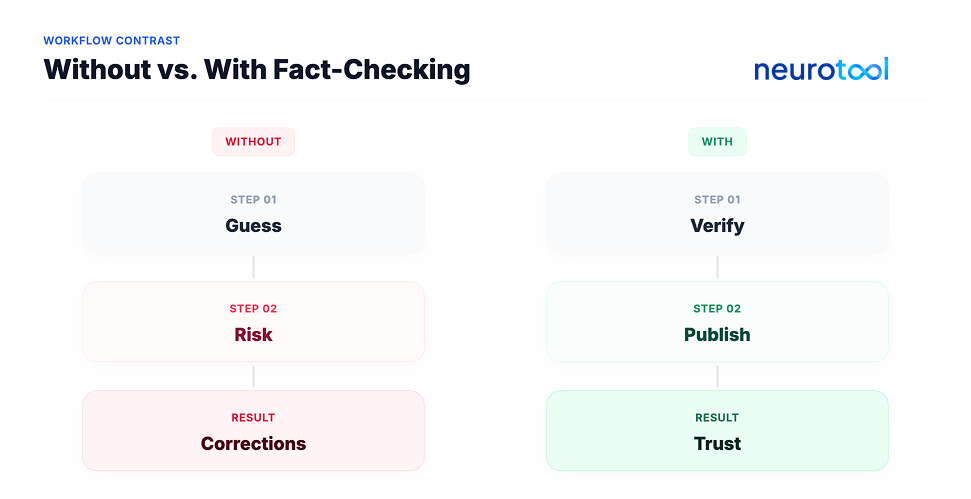
Agencies tend to think of fact-checking as protection against mistakes. That’s true. But in 2026, rigorous fact-checking is also a direct factor in getting featured in AI Overviews, ChatGPT, and Perplexity.
A regular article without structured sourcing is like a cluttered garage: everything’s in there, but try finding what you need in 10 seconds. A GEO-optimized article with verified facts is the same garage, but with labeled shelves. AI models “see” it differently.
According to research from Wellows, Google cross-references facts from content against authoritative databases in real time. Content with current statistics and Tier-1 primary sources has an 89% higher probability of being selected for citation in AI Overviews. Pages with strong E-E-A-T signals are cited 2.3 times more often.
According to SEO-Kreativ, Google’s March 2026 update was the most volatile in history — 24.1% of pages dropped out of the top 10. The pattern is consistent across all three updates over four months: original content with factual rigor grew. Paraphrased content without verified sources fell.
That’s exactly why fact-checking is an investment in traffic, not just in reputation.
What This Means for Your Content
A familiar scenario: an agency promises fact-checking, the articles come out fast, they look convincing. Three months later, the client discovers that one of the key figures in an article doesn’t actually exist. Competitors have already screenshotted it. It ended up in a LinkedIn post with 40,000 views.
The reputational damage from one incorrect figure outweighs the savings from cheap content.
This isn’t a scare story. It’s what happened to Deloitte, one of the largest consulting firms in the world. Twice in one year. In two different countries. With budgets in the hundreds of thousands of dollars.
If it can happen there, it can definitely happen in your blog. The only difference is who notices it, and when.
We made fact-checking not an optional add-on, but a mandatory part of every article. Because content that can’t be trusted isn’t content. It’s a risk.
Sources
Deloitte allegedly cited AI-generated research in a million-dollar report for a Canadian provincial government — Fortune (November 2025)
Large Legal Fictions: Profiling Legal Hallucinations in Large Language Models — Stanford Law School / Journal of Legal Analysis (2024)
Vectara Hallucination Leaderboard — Vectara (2025)
What Is Human-in-the-Loop AI — MindStudio (February 2026)
Google AI Overviews Ranking Factors: 2026 Guide to Winning Citations — Wellows (February 2026)
March 2026 Core Update Caused More Volatility Than December’s — SE Ranking (April 2026)
FAQ
About the Authors
This article was written by Neurotool copywriters: a team that has produced 1,000+ articles across 18+ industries since April 2025. Each writer works with our proprietary 15-agent AI system, which handles research and analysis at a scale no manual process can match.
The copywriters make every editorial decision: competitor and audience analysis, structure, SEO + GEO optimization, and final fact-checking. AI speeds up the work; humans control quality at every stage.
Learn more about how our technology works →
Start with One Test Article
A full article, completely free. No card, no contract.
- Ready from 24 hours — fast results
- Live copywriters review every word
- 2-3 revision 2-3 revision rounds included free
- Convenient platform Convenient platform for ordering and communication