
AI Traffic in the First Half of 2026: What Grew, What Fell, and Why It’s Changing Everything
Organic search is losing clicks. AI traffic is growing by hundreds of percent. But the picture isn't as simple as it looks.
- Traffic from AI platforms grew 357% year over year, the fastest-growing channel on the web. Its share is still only around 1% of total traffic, but it converts several times better than organic
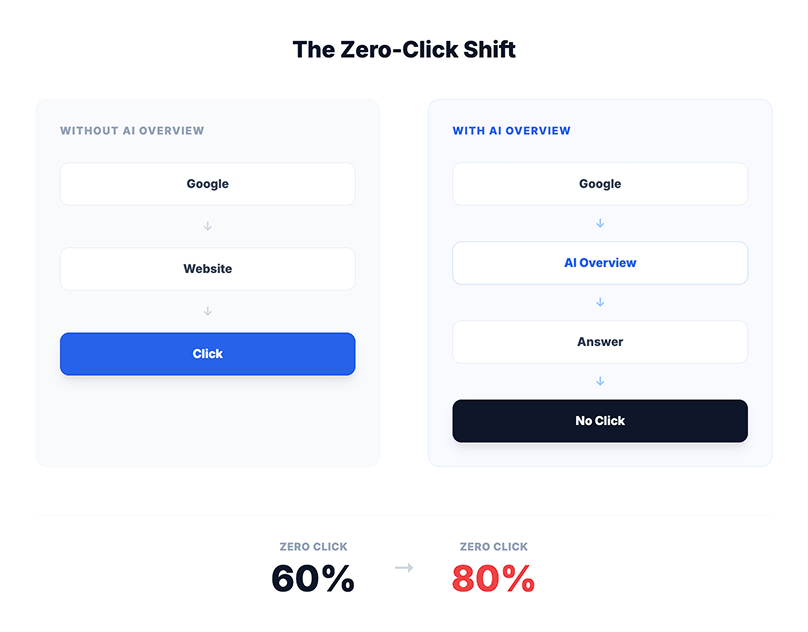
- 60% of all Google search queries end with zero clicks to a website. With an AI Overview present, that's already 80–83%
- AI traffic converts significantly better than organic — various studies put it at 4.4x to 5x on average across the market
- 70.6% of visits from AI platforms aren't visible in standard analytics — they get logged as "direct traffic" and go unattributed
- Over 8 months, ChatGPT's share of AI referral traffic dropped from 89% to 63% — Claude, Gemini, and Perplexity together are claiming more and more of it
AI referral traffic is visits to a website originating from AI platforms: ChatGPT, Perplexity, Claude, Gemini, and others. In the first half of 2026, this channel became the fastest-growing one on the web, increasing more than 340% year over year. But this growth is happening against the backdrop of a structural shift: organic traffic from Google is simultaneously losing clicks due to zero-click search and AI Overviews. Both trends exist in parallel, and together they’re changing the logic behind content strategy.
Two Trends Nobody Shows Side by Side
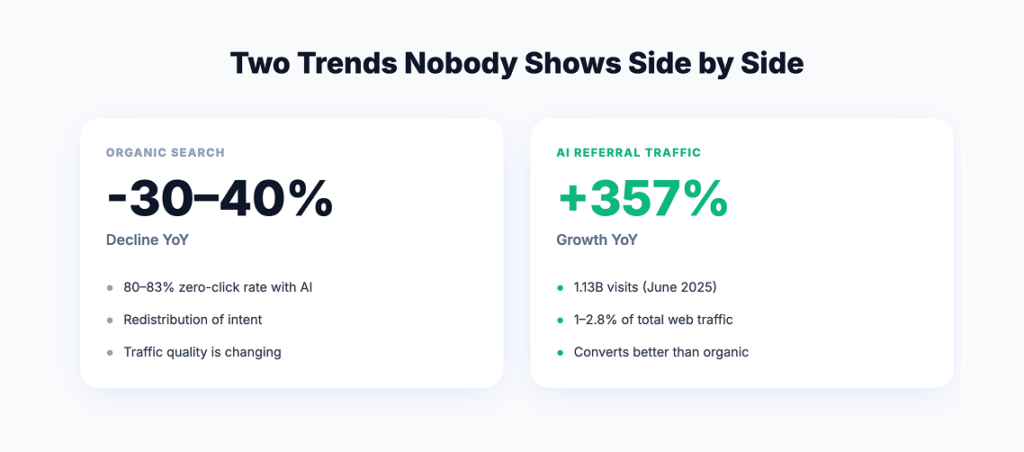
You look at an SEO report, organic is falling. You look at an AI traffic report, growth of hundreds of percent. Most people read these in isolation and draw the wrong conclusions.
Here’s the truth that needs to be held in mind simultaneously.
According to Similarweb, in June 2025 AI platforms generated 1.13 billion visits to the thousand largest websites, a 357% increase year over year. Conductor records a similar picture for all of 2025: +340% in AI referral traffic. At the same time, in absolute numbers, AI traffic is still only 1–2.8% of total web traffic.
At the same time: 60% of Google search queries end with no click. With an AI Overview in the results, it’s 80–83%. Organic traffic for publishers has dropped 30–40% year over year.
AI hasn’t replaced organic search. It’s redistributed it. Queries now get partially resolved right inside the search engine, or in ChatGPT. The people who do reach a website arrive with a different intent. This is a different kind of traffic. It behaves differently.
How differently — we’ll get into in the next section.
Small in Volume, Big in Quality: What AI Traffic Actually Does on a Site
This is where most companies get it wrong.
They see “1% of total traffic” and file AI traffic under “monitor, but don’t prioritize.” They don’t look at what that 1% is actually doing on the site.
According to the Gen AI Website Traffic Report (February 2026):
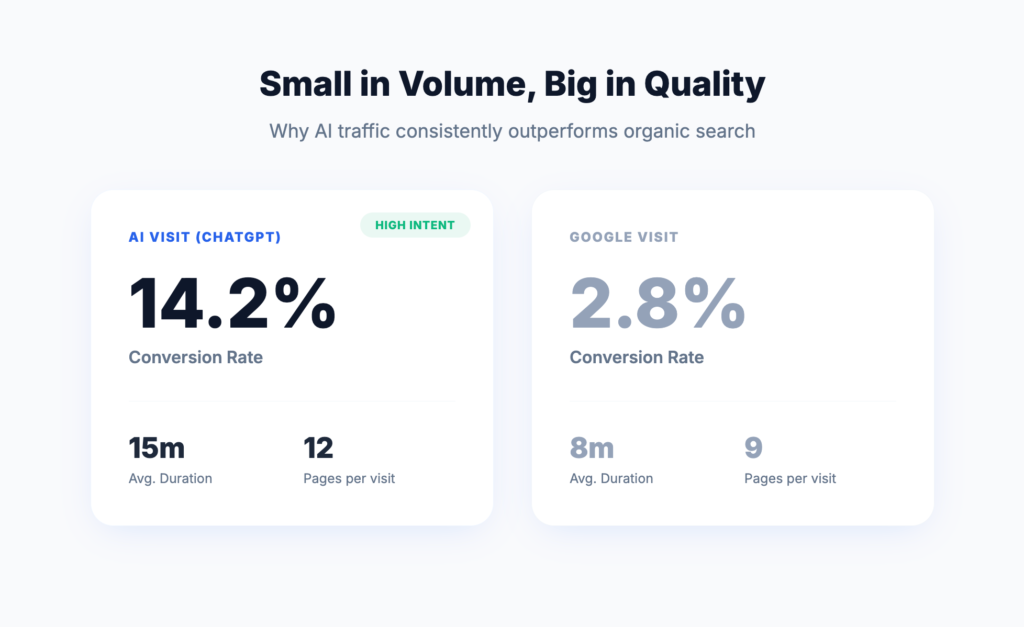
- ChatGPT users spend 15 minutes on a site, versus 8 minutes for visitors from Google
- ChatGPT users view 12 pages per visit, versus 9 for Google users
- AI traffic converts at 14.2% versus 2.8% for regular organic traffic — a ChatGPT user has already made a decision before clicking
- Claude consistently generates the most valuable traffic of any platform — its users arrive with the most pronounced research intent
Separately, Averi’s B2B SaaS citation benchmarks found Perplexity users visit an average of 13 pages, versus 11.8 for Google.
The mechanics are simple: a user coming from an AI platform has already gotten an answer to their initial question. They’ve come for details, for a product, for a contact. They’re further along in the funnel.
An organic user is searching. An AI user is choosing. These are different stages of the decision-making process.
AI traffic consistently converts better than organic, various studies put the figure at 4.4x to 5x on average across the market, and higher in certain niches. This isn’t a margin of error. It’s a structural difference in intent.
ChatGPT Is Losing Its Monopoly — the Market Is Now a “Big Four”
Eight months ago, a single player controlled AI referral traffic almost exclusively. Now the picture looks different, and that’s changing optimization strategy.
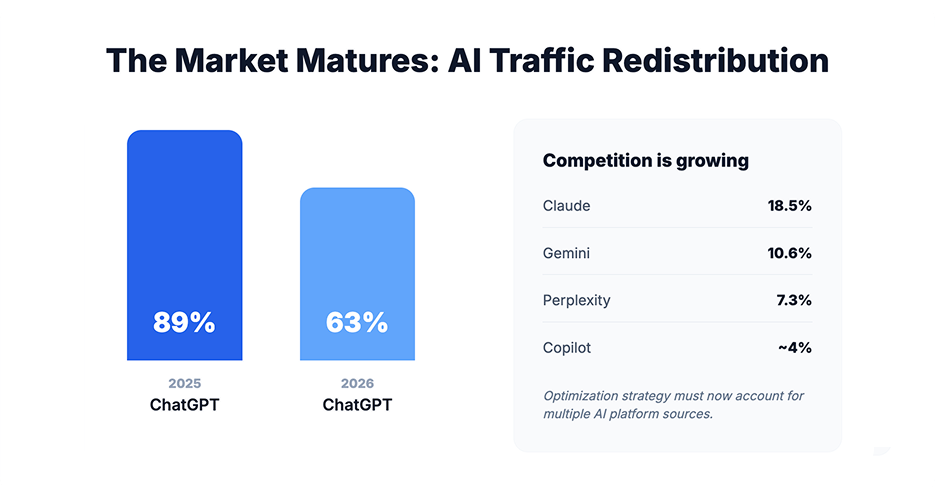
According to Goodie (May 2026), in May–August 2025, ChatGPT held 89.1% of all AI referral traffic. By March–April 2026, that had dropped to 62.6%.
Down 26 percentage points in eight months. Not because ChatGPT got worse, but because the market grew up around it.
| Platform | Share of AI Referral Traffic |
| ChatGPT | 62.6% |
| Claude | 18.5% |
| Gemini | 10.6% |
| Perplexity | 7.3% |
| Copilot | ~4% |
Claude grew from 1.4% to 18.5%. Gemini quadrupled. Perplexity more than doubled. The Big Four together hold 99% of the market.
The practical takeaway: optimizing only for ChatGPT means ignoring more than a quarter of AI referral traffic. Claude and Gemini have their own source logic. They cite differently. The “write an article, get picked up everywhere” strategy doesn’t work.
What’s Happening With Organic — and One Twist Most People Miss
You can’t talk about AI traffic growth without talking about where the losses are coming from.
Google AI Overviews now appear in 25% of all search queries as of Q1 2026, up from roughly 13% a year ago — though estimates vary widely by dataset (from ~15% to ~50%), depending on query mix. When an AI Overview is present in the results, the user gets their answer right there on the Google page. The site never gets opened.
The consequences: organic CTR has dropped 61% (Seer Interactive). Publisher traffic has declined 30–40%. According to Graphite (via Search Engine Land), total organic traffic in the US fell 2.5% year over year.
And now here’s the twist that changes how all these numbers should be interpreted.
Datos’s research found that brands cited in AI Overviews get 35% more organic clicks than brands that aren’t cited. AI Overview isn’t killing traffic for brands that appear in it. It’s killing traffic for brands that don’t.
The clicks haven’t disappeared. They’ve shifted toward whoever made it into the neural network’s answer.
Legal Services Grew 823%. This Is Where AI Traffic Is Already Critical
Growth isn’t evenly distributed across niches, and the gap between them is dramatic.
According to Superprompt (legal, finance, healthcare data) and Conductor (IT data), compiled by Thestacc (April 2026):
- IT and technology — 2.8% of total traffic from AI. Leader by volume
- Legal services — 1.34%, growth of 823% year over year
- Finance — 1.21%
- Healthcare — 0.89%
823% for the legal niche isn’t a typo. People are increasingly asking AI systems questions about law, taxes, finance. The platforms look for authoritative sources to cite. Law firms with properly structured content are capturing this traffic. Everyone else isn’t.
For B2B SaaS, law, medicine, and finance, AI traffic is already a priority, not an experiment. But even if your niche isn’t on this list, there’s another problem that most analytics reports don’t address directly.
Hidden Traffic: Why You’re Not Seeing 70% of Your AI Visits
According to the Gen AI Website Traffic Report, 70.6% of all visits from AI platforms go unattributed in standard analytics. They land in “direct traffic,” and look as though the user simply typed in the URL manually.
The reason: some AI platforms don’t pass along data about the referral source. Some visits route through mobile apps. Some go through browser extensions. GA4 wasn’t built to track AI traffic.
In practical terms, this means: if your analytics shows 1% AI traffic, the real number is probably 3–4 times higher.
That’s exactly why we build GEO optimization into the production process from the very first step, rather than bolting it on afterward.
What We Build Into Every Article — and Why It Isn’t Theory
GEO blocks (a 40–60 word direct answer right after the H1) — this is exactly the format that gets extracted by AI Overviews and Perplexity. According to Wellows, real-time fact-checking of content can boost AI Overview selection probability by 89%.
Verified sources — according to Wellows, pages with strong E-E-A-T signals are cited 2.3 times more often.
A platform ecosystem — YouTube, Reddit, LinkedIn function as AI citation donors alongside the content on the website itself.
The bottom line: AI traffic doesn’t just show up on its own. It’s generated by content written in a way that a neural network can cite it, and wants to.
SEO or GEO Is the Wrong Question
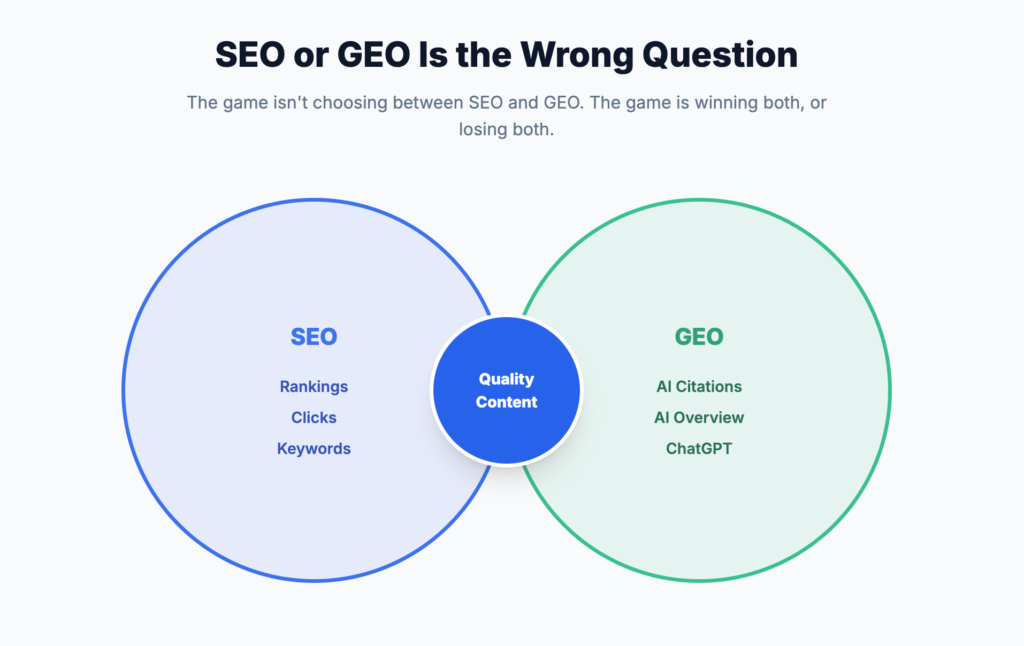
The first half of 2026 made one thing clear: this isn’t a choice between two strategies. It’s one structural shift with two sides.
On one side is organic search, losing clicks wherever AI delivers the answer first. On the other is AI traffic, converting significantly better than organic. Most companies don’t see it in their analytics, don’t optimize for it, and so don’t get it.
ChatGPT processes 2 billion queries a day. Some portion of those end in a visit to a website. The only question is whose website.
The game isn’t choosing between SEO and GEO. The game is winning both, or losing both.
Sources
Wellows — Google AI Overviews Ranking Factors — https://wellows.com/blog/google-ai-overviews-ranking-factors/
Similarweb — AI Referral Traffic Winners 2025 (July 2025) — https://techcrunch.com/2025/07/25/ai-referrals-to-top-websites-were-up-357-year-over-year-in-june-reaching-1-13b/
Conductor — AEO & GEO Benchmark Report (2026) — https://pressonify.ai/blog/conductor-aeo-geo-benchmark-2026-ai-referral-traffic
Digital Bloom — Gen AI Website Traffic Share Report (February 2026) — https://thedigitalbloom.com/learn/gen-ai-website-traffic-share-february-2026/
Averi — ChatGPT vs. Perplexity vs. Google AI Mode: B2B SaaS Citation Benchmarks (2026) — https://www.averi.ai/how-to/chatgpt-vs.-perplexity-vs.-google-ai-mode-the-b2b-saas-citation-benchmarks-report-(2026)
Goodie — 2026 AI Search Traffic Report: ChatGPT Is Slipping (May 2026) — https://higoodie.com/blog/ai-search-traffic-report-2026/
Seer Interactive — organic CTR impact of AI Overviews (via Thestacc) — https://thestacc.com/blog/google-ai-overview-statistics/
Graphite (via Search Engine Land) — US organic traffic trend — https://thedigitalbloom.com/learn/organic-traffic-crisis-report-2026-update/
Datos — cited-brand organic click lift — https://thedigitalbloom.com/learn/organic-traffic-crisis-report-2026-update/
Superprompt (legal, finance, healthcare data) and Conductor (IT data), compiled by Thestacc (April 2026) — https://thestacc.com/blog/ai-search-referral-traffic-stats/
FAQ
About the Authors
This article was written by Neurotool copywriters: a team that has produced 1,000+ articles across 18+ industries since April 2025. Each writer works with our proprietary 15-agent AI system, which handles research and analysis at a scale no manual process can match.
The copywriters make every editorial decision: competitor and audience analysis, structure, SEO + GEO optimization, and final fact-checking. AI speeds up the work; humans control quality at every stage.
Learn more about how our technology works →
Start with One Test Article
A full article, completely free. No card, no contract.
- Ready from 24 hours — fast results
- Live copywriters review every word
- 2-3 revision 2-3 revision rounds included free
- Convenient platform Convenient platform for ordering and communication