
Why AI Doesn’t Write About You — and How a Personal Knowledge Base Fixes That
Most AI agencies write from the neural network's memory — and end up with hallucinations. We write from the client's knowledge base. The difference shows up in every fact.
- A properly built RAG system reduces hallucinations by 40–71% in production — but only when it's not built off a standard tutorial.
- AI with access to 50 of a client's videos writes more accurately than AI working from a standard prompt
- A RAG system can hold a practically unlimited volume of material — something that simply can't fit into a neural network's standard context
- Without a personal knowledge base, AI writes from a general data pool, not from your actual materials
- Roughly 60% of production AI projects in 2025–2026 combine RAG with fine-tuning — because a single prompt no longer solves the quality problem.
RAG (Retrieval-Augmented Generation) is a way for AI to work with information: before producing an answer, the system searches a defined knowledge base for the relevant data and bases its answer on it.
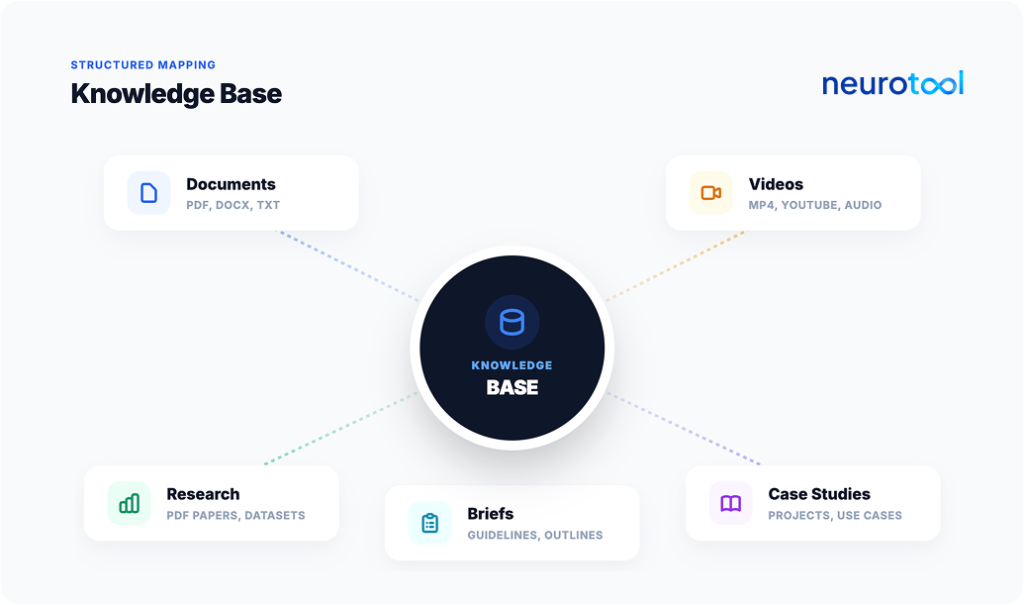
At Neurotool, we use this approach to build a personal knowledge base for each client — from their documents, YouTube video transcripts, research, and briefs. AI writes articles only from that base.
New Employee. First Day. Article Due by Morning.
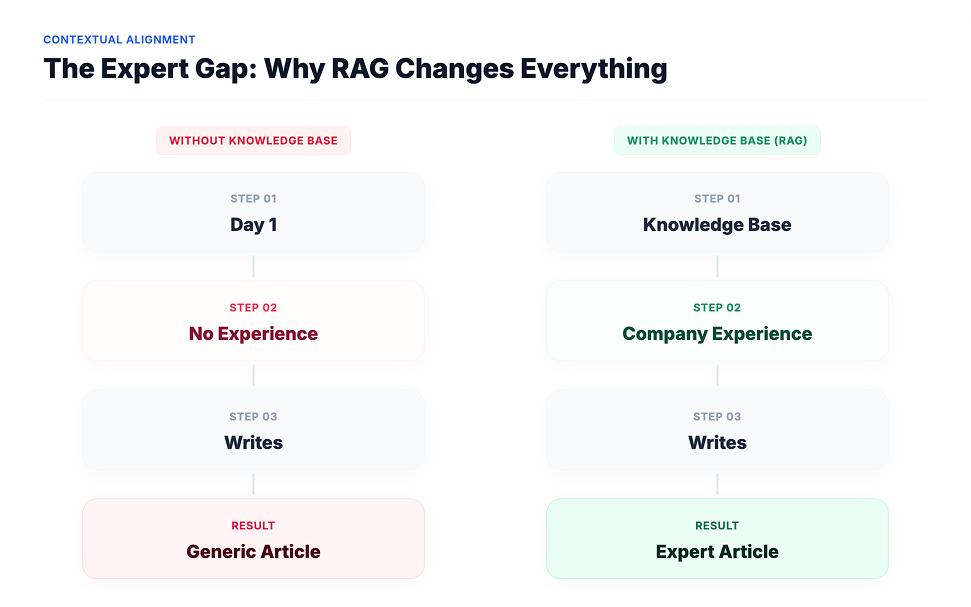
Imagine: you’ve hired someone. They’re smart, write well, pick things up fast. But today is their first day — they haven’t read a single one of your case studies, haven’t watched your YouTube videos, don’t know how your methodology differs from your competitors’.
That evening, you ask them to write an expert article on behalf of the company.
What will they write? Whatever sounds plausible for your niche. Whatever “people usually say” in articles like that. They’ll compile something from general knowledge — and it’ll read fine. But it won’t be your article.
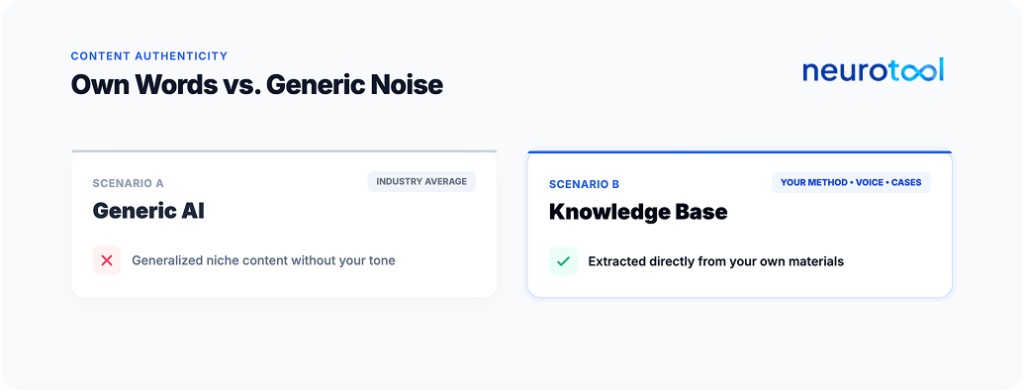
That’s exactly how AI works without a personal knowledge base: the model writes whatever is statistically similar to a good article in your niche. Not yours. The industry average.
For generic content, that’s enough. But the moment a client wants their articles to sound like them, to contain their case studies and their methodology, they need their own knowledge base. That’s exactly what we call our RAG system: a personal knowledge base for the client, which AI uses to write every article.
How It Works — Without the Technical Jargon
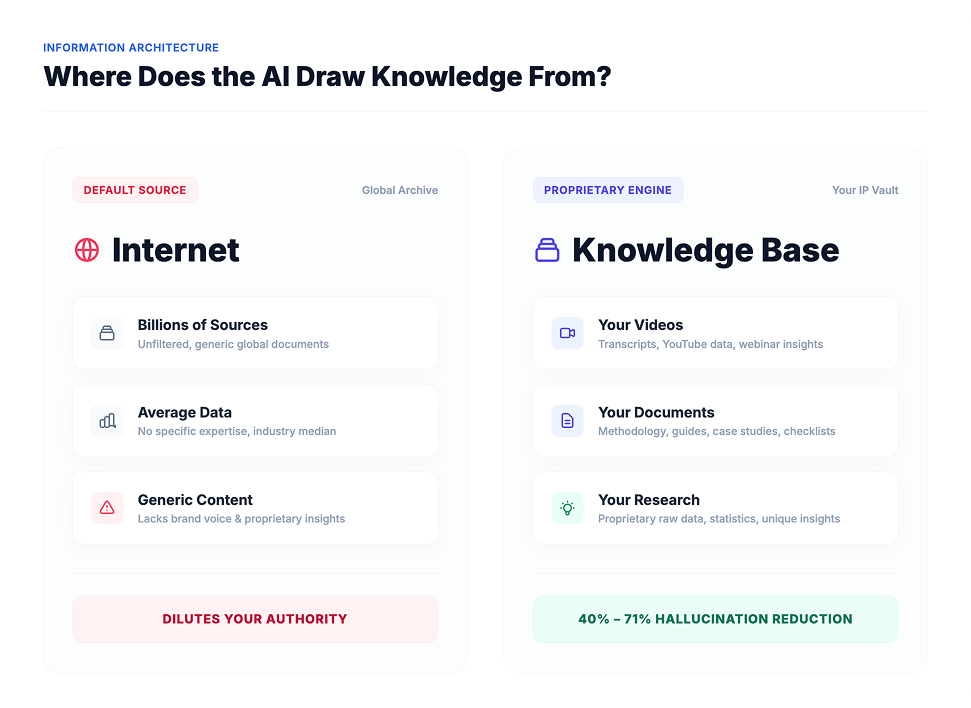
Every language model works with some kind of knowledge base. The only question is which one. By default, it’s the entire internet: billions of texts, averaged across every niche and author. When you ask it to write an article about your company, the model goes to that general pool and pulls back whatever’s there about companies like yours.
Our system works differently. We give AI only your materials: videos, documents, case studies, research. The model isn’t drawing from a global archive — it’s drawing from your personal knowledge base, and it writes only from that.
The difference is in scale: a global model knows a little bit about everything, but very little specifically about you. A personal knowledge base contains only your materials, nothing extraneous. AI works exclusively with them. Built for you.
According to Blockchain Council‘s April 2026 data, a properly built RAG system reduces hallucinations by 40–71%.That’s the difference between “AI writes what sounds plausible for your niche” and “AI writes what’s actually in your materials.”
Three Situations Where a Personal Knowledge Base Changes the Result Completely
The theory is clear. Now, specifically: here are three scenarios from our own practice where, without RAG, we simply couldn’t have done the work honestly.
A YouTube channel: 40 videos as the only source of truth
Here’s a pattern we see regularly. A client has been running a YouTube channel for years. It contains their methodology, their case studies, their phrasing. They want the SEO articles on their website to sound exactly like how they talk in their videos. Not “how it’s usually done in the industry” — in their voice, with their examples, their logic.
The problem: 40 videos at 20–60 minutes each comes out to thousands of pages of text once transcribed. There’s no way that fits into any standard context window. And if you have to pick and choose what to include, that’s no longer their voice — it’s our selection from their voice.
What we do: transcribe all the videos → build a personal knowledge base from all of them → when writing each article, AI goes into the base and pulls facts, examples, and quotes from exactly there. Not a single fact from the model’s training data — only the client’s own words.
The resulting article reads as if it was written by someone who watched every video, took notes on the key points, and then sat down to write. Because that’s essentially what’s happening. Just automatically.
Internal documents: when the gold is sitting in a folder no one ever opens
Most B2B clients have a huge volume of internal documentation: their own research, reports, case studies with real numbers, methodology materials. All of it is extremely valuable content. And all of it usually goes unused, because physically loading 200 documents into a neural network isn’t possible.
A personal knowledge base for the client gets built from that entire archive. From there, AI finds what it needs on its own and writes only from that source.
The result is simple: the articles are filled with the client’s real data, not generalized industry statistics pulled from the internet. It’s noticeable immediately, both to the reader and to the search engine.
Niche expertise: medicine, law, dentistry
This is a separate conversation, and honestly, the stakes here are the highest of all.
For YMYL niches, generic AI content is a risk. The model doesn’t know the specifics of your clinic, your jurisdiction, your protocols. It knows what’s “usually written” in dentistry articles. That’s not enough.
We load the knowledge base with specific materials: clinical protocols, regional legislation, approved methodologies, the client’s internal standards. When writing an article, AI draws on this base, and instead of guessing, it pulls specific information from a specific source.
RAG Isn’t Always Needed. Here’s When It Is — and When It Isn’t
We’re not going to convince you that the RAG approach is necessary for everyone. That would be dishonest.
There’s a simple line.
A RAG system is needed when:
- There’s a lot of material — 40+ documents, 30+ videos, regularly updated data
- The work is ongoing, not a one-off
- It matters that AI writes specifically from the client’s materials, not from general knowledge
- The niche requires specific precision: medicine, law, finance
RAG isn’t needed when:
- There isn’t much material — a handful of texts and 5–10 videos
- It’s a one-off project, not a systematic content plan
- The topic doesn’t require strict adherence to the client’s sources
In these cases, it’s enough to load the materials directly into the neural network’s context. Faster, simpler, cheaper.
A personal knowledge base solves a scale problem. When there’s a lot of material, it’s necessary. When there’s not much, you can do without it.
What You Get as a Result — and Why It Affects Rankings
Three results that are visible immediately, and one that becomes visible after a month.
Articles sound like you, not like “AI writing about you.” You can hear it from the first paragraph. Your phrasing, your examples, your logic. A reader who already knows your brand won’t feel a gap between what you say in your videos and what’s written in the blog.
Scale. 100 articles from a single knowledge base, with no contradictions between texts, no repetition, no “in the last article we said one thing, in this one something else.” Every article is written from the same source, so the voice, the facts, and the logic stay consistent.
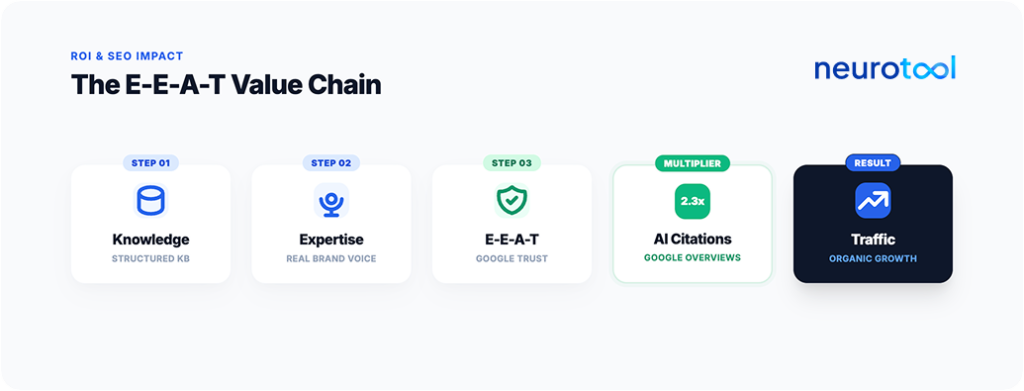
E-E-A-T — not an imitation, a fact. And here’s the result that shows up after a month. According to Wellows, pages with strong E-E-A-T signals are cited 2.3 times more often in Google AI Overviews. In 2026, Google is good at telling real expertise apart from an imitation of it. Content written from a client’s actual materials is E-E-A-T. Not because a guideline says so, but because there’s real knowledge from a real expert behind the text.
Content From Your Own Words — Or Content That Anyone Could Have Written
A client orders articles from an AI agency. The articles come out fast. They look fine. But read closely, and it’s not their voice. Not their examples. Not their logic. It’s generalized niche content dressed up to look like their brand.
A reader who knows the client can feel it. A search engine that evaluates expertise can too.
RAG doesn’t make content smarter. It makes it more precise. More precise to what you actually say, think, and know. That’s the difference between content that works and content that simply exists.
We chose the former.
Sources
Blockchain Council —Reducing AI Hallucination in Production: RAG Guide (April 2026)
How to Evaluate RAG Systems: Metrics & Benchmarks 2026 (April 2026)
Wellows —Google AI Overviews Ranking Factors (February 2026)
ScalaCode —RAG vs Fine-Tuning 2026 (May 2026)
FAQ
About the Authors
This article was written by Neurotool copywriters: a team that has produced 1,000+ articles across 18+ industries since April 2025. Each writer works with our proprietary 15-agent AI system, which handles research and analysis at a scale no manual process can match.
The copywriters make every editorial decision: competitor and audience analysis, structure, SEO + GEO optimization, and final fact-checking. AI speeds up the work; humans control quality at every stage.
Learn more about how our technology works →
Start with One Test Article
A full article, completely free. No card, no contract.
- Ready from 24 hours — fast results
- Live copywriters review every word
- 2-3 revision 2-3 revision rounds included free
- Convenient platform Convenient platform for ordering and communication