
Why Audience Analysis Is the First Thing We Do Before Writing a Single Word
Your audience isn't who you think they are. And that's exactly why your content gets read but not bought.
- Most SEO articles are written for a person who doesn't exist
- Content can rank #1 on Google — and still bring in zero leads
- One wrong tone in an article can drive away an audience more effectively than having no content at all
- A client's competitors can help you understand their audience better than the client themselves
- Audience analysis isn't a marketing formality — it's a technical spec for AI
You’re Ranking. There Are No Leads. Here’s Why
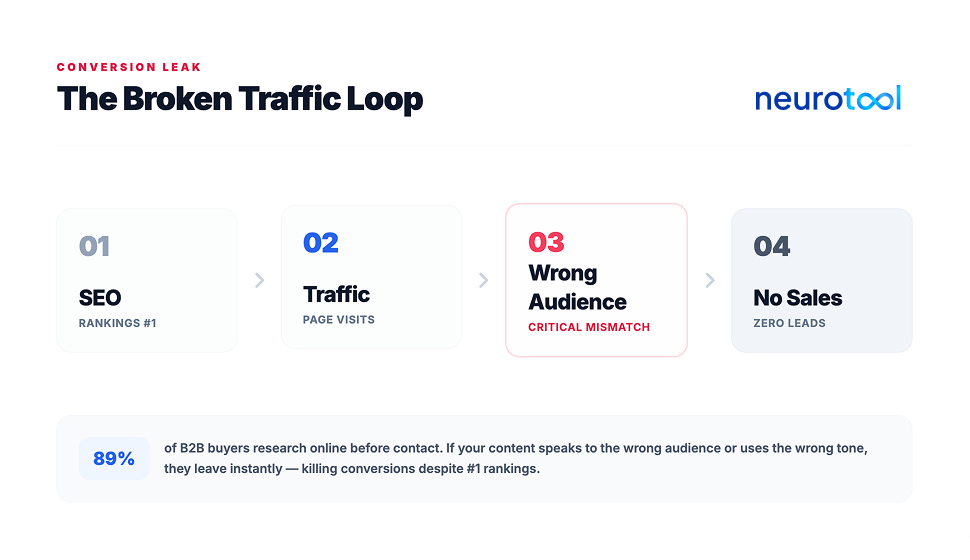
A familiar situation: a company orders 20 articles. All of them rank #1 for the target queries. Traffic grows. Leads — zero.
The first reaction is always the same: something must be wrong with the SEO. An audit of keywords begins, meta tags get tweaked, load speed gets checked. But the problem isn’t there.
The articles were written for a person who doesn’t exist. The marketer invented that person based on a hunch — and wrote for them. The real reader lands on the page, reads the first two paragraphs, and leaves. Because the tone is wrong. Because the pains are wrong. Because the text answers a question they never asked.
According to DemandSage‘s 2026 data, 89% of B2B buyers research a product online before their first contact with a sales rep, and 60% make their final purchase decision based on digital content. Your articles function like a salesperson — except without any understanding of who’s standing in front of them.
Knowing your audience solves exactly this. Not abstractly, but technically: what tone to choose, which objections to address in the third paragraph, which queries to target at the problem-awareness stage versus the decision stage.
Without it, a content strategy is just a nice plan with no delivery address.
That’s why at Neurotool we don’t start writing a single article until the target audience analysis document is ready. Not as an onboarding formality. As the technical foundation everything else rests on.
Where the Information Comes From — and Why Competitors Matter More Than the Client Themselves
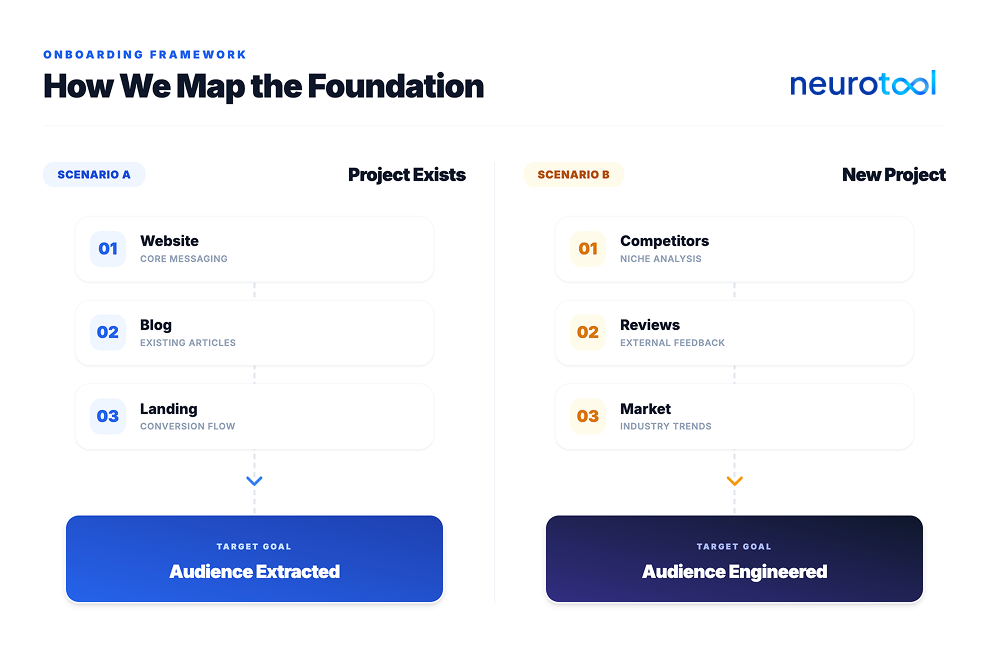
The first question in onboarding is always the same: what do you already have?
The answer determines the entire process. Two scenarios come up most often — each with its own logic.
Scenario A — content exists and it’s working. A landing page, a blog, service page copy. We pull all of it in and analyze: how the client describes their audience, what pains they mention, what tone they use.
A separate source of value is customer reviews — and not just the ones on the company’s own site, but from external, independent platforms: Google Reviews, Trustpilot, industry forums, aggregators. That’s where people speak in their own words — not polished marketing phrasing, but the raw language of real pains and expectations. This is the most precise material for building an audience portrait: a person doesn’t write a review for the company, they write it for themselves and people like them.
The most precise insights are often hiding not in the headlines, but in the FAQ section, or in the objections a client preemptively addresses on their landing page. These are live traces of real conversations with buyers.
Scenario B — there’s almost no project yet. A new product, a new market, minimal history. Here, we turn to competitors. 3–5 players in the niche, copy pulled from their websites, a separate tab in the working document. The goal isn’t to copy their approach, but to use the contrast to pull out the client’s USP.
What do competitors say that the client stays silent on? What can the client do that competitors don’t offer? The answers to these questions shape the positioning that later goes into every article.
We learned this through experience: a client can rarely describe their audience accurately. They’re too close to the product. Competitors are a mirror of the market. It’s through them that you see what the market already knows about these people — and where the unclaimed space is.
Competitor analysis is always stored separately from client data. This isn’t an extra precaution — it’s a discipline that keeps someone else’s voice from leaking into the brand we’re building.
The 6 Sections We Build Into Every Audience Analysis Document
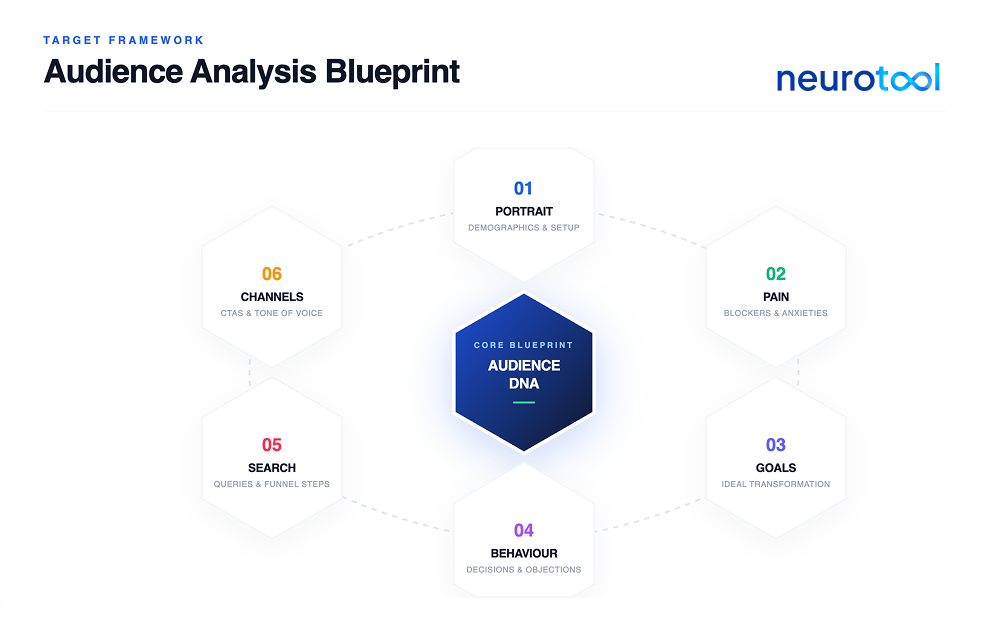
Neurotool’s target audience analysis document consists of six sections. Each one solves a specific problem during content writing.
1. Portrait and demographics. Age, gender, job title, income level, company size, geography. Sounds basic — but this section determines whether you need to explain basic terms or can go straight into depth. “Men 30–45” and “marketing directors at SaaS companies with 50+ employees” are two completely different articles, even on the same topic.
2. Problems and pains. The main pain — the one keeping them up at night. This section determines topics and headlines. If you know the main pain is “I’m losing leads because my site doesn’t rank,” then the headline “How to Get Your Site to the Top of Google” hits directly. An abstract “SEO Guide” doesn’t.
3. Desires and goals. How the person envisions the ideal outcome. What transformation they’re seeking. This section shapes the CTA: calls to action need to speak the language of desire, not the language of services.
4. Behavioral factors. How they make a purchase decision. The main objections. This is the most underrated section — it’s exactly where the material for handling doubts inside the article comes from. A good piece of content closes objections before the reader has even formed them.
5. Search behavior. Queries at each stage of the funnel: problem awareness → solution search → decision-making → hot commercial queries. A direct bridge between audience analysis and the keyword core. Without this section, keywords are just words. With it, they’re a map of the customer journey.
6. Communication. Effective CTAs for this audience, Tone of Voice, preferred channels. This section works in tandem with the ToV document — together they define how every article sounds.
Once the document is ready, it’s uploaded into the project as permanent context. Every article is written with it in view — the AI sees who it’s writing for, and that changes the quality starting with the very first draft.
How exactly we build a Tone of Voice — read about it in the next blog article.
What This Looks Like in Practice: A Chip-Tuning Case Study
The theory is clear. Let’s look at how it plays out on a real project.
One of our clients is GAN, a tuning module for cars in the European market. A technically complex product, a specific audience. Here’s what the audience analysis document revealed.
Portrait: men aged 30–49, owners of crossovers and sedans with automatic transmissions and turbocharged engines. Above-average income. Daily drivers. Technically literate — but skeptical of tuning in general.
Main fear: losing the dealer warranty.
Not just an objection — a blocker that stops the purchase at any stage of the funnel. We tested different approaches: without addressing this fear, the article simply didn’t work, no matter how much traffic it brought in.
Here’s how this looked in the objections section:
“I’ll lose my dealer warranty” — The module is removed in 1 minute before a visit to the dealer. Leaves no mechanical or electronic trace. Plug & play.
“This is dangerous for the engine” — The manufacturer provides an additional 2-year engine warranty. All factory safety systems function normally.
These aren’t marketing claims. They’re specific answers to specific fears held by a specific person. That’s exactly the form in which they went into the article structure.
Search behavior split into three stages — and that immediately produced three different types of content:
Awareness stage: “sluggish gas pedal,” “how to improve car acceleration without losing the warranty”
Solution-search stage: “tuning module or ECU remap,” “is chip tuning safe”
Decision stage: “GAN GT reviews,” “buy a tuning module with warranty”
Three stages — three types of articles. Three different tones. Three different CTAs. All of it determined by the audience analysis document, not by a copywriter’s intuition.
One last thing. It was clear from the start: a casual tone doesn’t work here. A 40-year-old man who commutes daily in a turbocharged crossover and is afraid of losing his warranty wants respect and facts. Not “hey, today we’re talking about cool upgrades for your ride.”
That’s not an opinion. That’s a conclusion drawn from the audience analysis document.
Why Keywords Without Audience Analysis Are Money Down the Drain
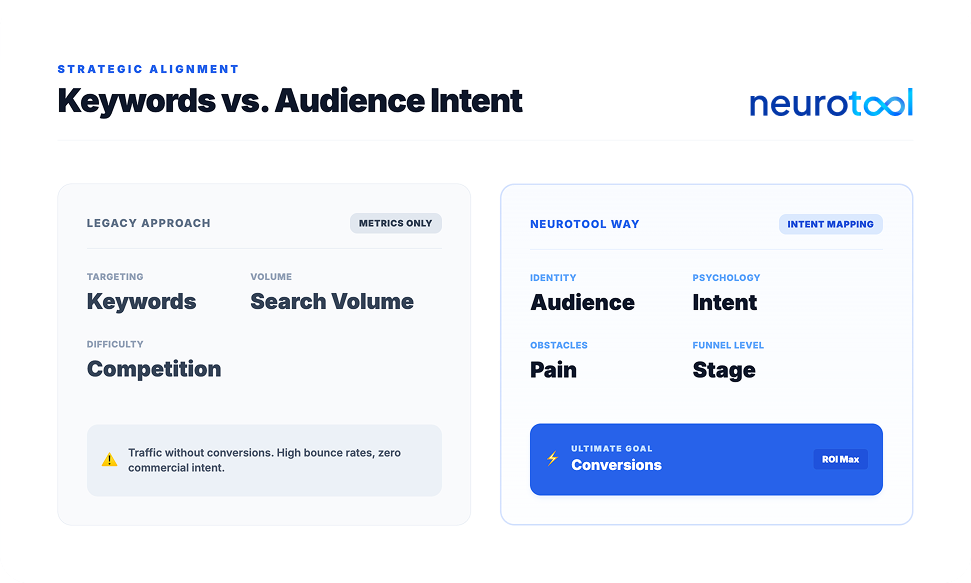
Most agencies build their keyword core separately from audience analysis. They gather keywords, group them by volume and competition — and that’s it.
The audience is somewhere nearby. But not inside the process. That’s a systemic mistake.
Here’s how it plays out in practice: you take a keyword with good search volume, write an article around it — and get traffic from people searching for something completely different. They don’t need your product. The words just happened to match.
According to Abstrakt Marketing Group, knowing what your audience is actually searching for directly improves SEO rankings — because Google today ranks content based on how well it matches search intent, not just keywords. An article that precisely answers a specific person’s question beats an article with flawless technical optimization but a blurry focus.
A person at the awareness stage doesn’t google “buy chip tuning.” They google “why does my car feel sluggish when accelerating.” Different articles. Different headlines. Different tone.
The search behavior section in the audience analysis document closes exactly this gap: from a portrait of the person to the words they actually type into the search bar at each stage of decision-making.
For GEO, this works the same way. Perplexity and ChatGPT cite content that precisely and fully answers a specific person’s question. The more precisely you understand your audience, the higher the chance your content ends up inside an AI’s answer, rather than just in Google’s index.
The Prompt We Use to Build the Audience Analysis Document
Below is an adapted version of the prompt we run during every client’s onboarding. Use it as a starting point.
What to attach before running it:
- The client’s landing page copy or website URL
- Copy from 3–5 competitors, pulled from their websites
- The client’s existing articles, if any
- Customer reviews — from the company’s own site and, especially, from external independent platforms (Google Reviews, Trustpilot, industry forums). People write in their own words there — and that’s exactly where the most accurate audience portrait comes from.
Prompt:
Conduct an in-depth analysis of the target audience based on the attached materials. This analysis will be used to write SEO-optimized articles.
Analysis structure:
- Portrait and demographics — age, gender, job title, income level, business size, geography
- Problems and pains — the main pain, what’s blocking them from reaching their goals, specific difficulties
- Desires and goals — what they want to achieve, how they envision the ideal outcome
- Behavioral factors — how they make decisions, main objections, where they look for information
- Search behavior — queries at each stage of the funnel: awareness → solution search → decision-making → hot commercial queries
- Communication — effective CTAs, Tone of Voice, preferred channels
Use the client’s landing page and the competitor analysis to pull out the USP and show what sets the client apart. Write specifically, with examples. No generic phrases.
Once the document is ready, it’s used as permanent context. Not a one-time instruction, but a living reference that every subsequent article draws on. This is exactly what ensures consistency of voice and precision in hitting the audience throughout the entire content strategy.
The Audience Analysis Document Isn’t an Archive. It’s a Living Tool
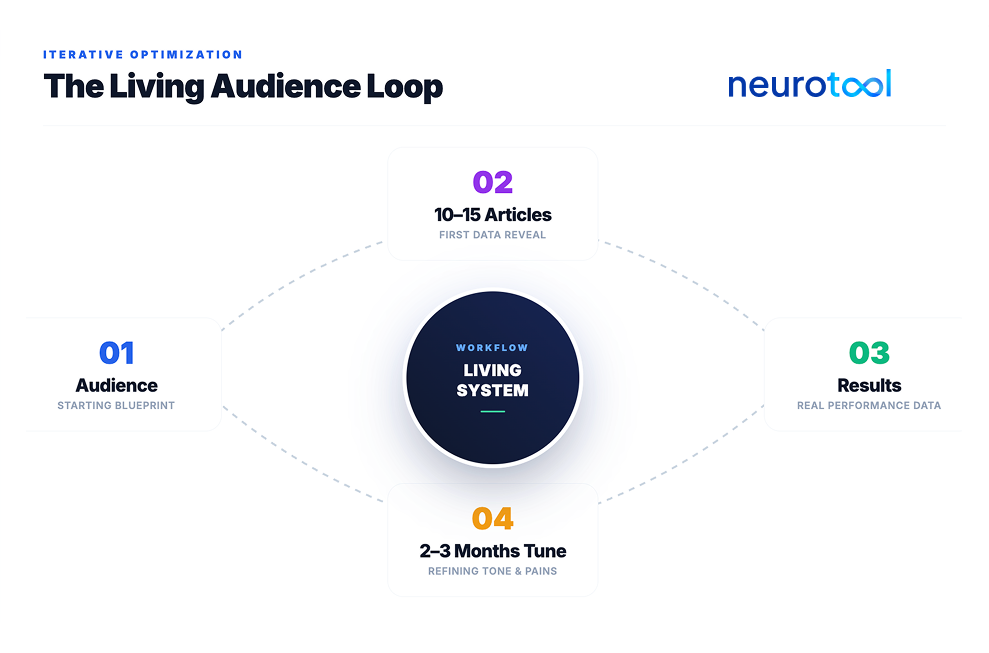
When we start working with a client, the audience analysis document is a starting point. Not a final one.
The first 10–15 articles always reveal something new. Sometimes it turns out the real audience is slightly older than assumed. Or that the main pain isn’t what the client described on their landing page, but something adjacent. Or that one segment converts significantly better than another — and the content plan should be reoriented around it.
That doesn’t mean the first version was bad. It means the system is working.
We update the document after the first results: refining, adding, adjusting the tone wherever the data says something different from the initial assumptions. After reviewing hundreds of client briefs, the pattern is clear: companies that revisit their audience analysis document after 2–3 months see significantly higher conversion from organic traffic than those who write it once and forget about it.
This isn’t theory. It’s an observation from practice.
Conclusion
Target audience analysis isn’t a step you can skip and come back to later. It’s the foundation everything else is built on: topics, headlines, tone, CTAs, keywords. Without it, even a technically perfect article misses the mark.
At Neurotool, we start every project with this document. An article written for a specific person with a specific pain always outperforms an article written “for everyone.”
Sources
DemandSage — 57 B2B Marketing Statistics 2026
Abstrakt Marketing Group — SEO and Content Marketing: How to Align Them for Better Rankings
Frequently Asked Questions
About the Authors
This article was written by Neurotool copywriters: a team that has produced 1,000+ articles across 18+ industries since April 2025. Each writer works with our proprietary 15-agent AI system, which handles research and analysis at a scale no manual process can match.
The copywriters make every editorial decision: competitor and audience analysis, structure, SEO + GEO optimization, and final fact-checking. AI speeds up the work; humans control quality at every stage.
Learn more about how our technology works →
Start with One Test Article
A full article, completely free. No card, no contract.
- Ready from 24 hours — fast results
- Live copywriters review every word
- 2-3 revision 2-3 revision rounds included free
- Convenient platform Convenient platform for ordering and communication