
How to Build an SEO Content Plan From Scratch: The Methodology We Use for Every Client
Most companies start their content plan with topics. That's the core mistake.
- Companies that publish 9+ articles a month get 20% more traffic — but only if the articles are written for the right topics
- HubSpot lost up to 80% of its organic traffic in a single quarter — because of content outside its area of expertise
- 83% of B2B buyers form their purchase requirements before ever talking to a salesperson — your content plan decides whether you even make it onto their shortlist
- A list of topics isn't a content plan yet: without meta data, keywords, and structure it's just a list of ideas
- The right sequence of steps when building a content plan matters more than the tools you use
- Competitor analysis without data is guessing: Ahrefs shows you which articles actually drive traffic before you've even read a single one of them
An SEO content plan is a structured document where every topic is turned into a technical brief: with a headline, meta tags, target keywords, and a basic article structure. A well-built content plan lets you write articles without additional briefs and ensures coverage of the keyword core across every stage of the funnel. Companies that prioritize blogging as a channel are 13 times more likely to report strong SEO ROI — but only with a systematic approach to planning.
You Have Content. You Don’t Have Traffic. Sound Familiar?
A marketer pulls the team together, they brainstorm 50 topics — some pulled from their heads, some pulled from looking at competitors. The topics look reasonable. The articles get written. The traffic doesn’t grow.
The first reaction is always to improve the writing. Hire an editor. Add more keywords. But the problem isn’t the quality of the writing. The problem is that the plan was built in the wrong order — and no editor can fix that.
The real question is different: which articles in your niche are already driving traffic to your competitors — and why those specific ones?
According toThe Growth Syndicate’s 2026 data, HubSpot lost up to 80% of its organic traffic following Google’s algorithm updates. The reason: thousands of articles on topics outside its area of expertise — resume templates, celebrity quotes, real estate guides. None of those articles were badly written. They simply shouldn’t have existed. This isn’t a story about bad content. It’s a story about a content plan with no strategy.
Three mistakes we see constantly — and all three are systemic, not isolated:
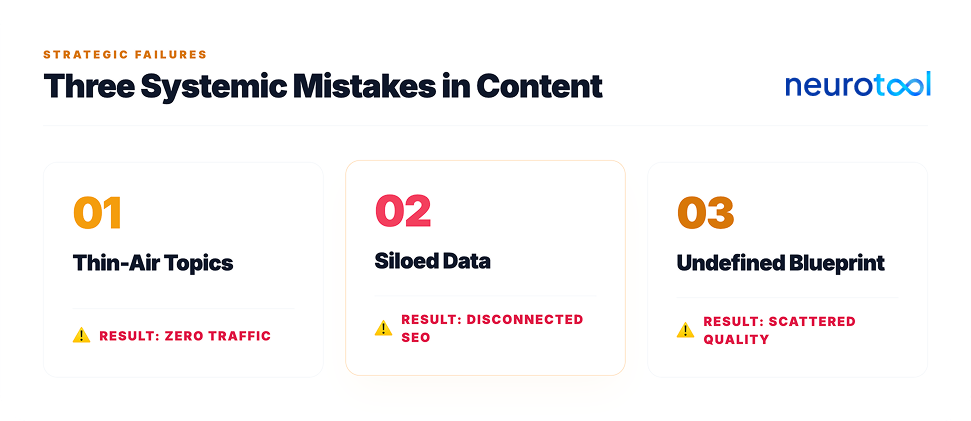
Topics are pulled out of thin air, not from keyword data. You think “our audience wants to know this” — and you write for an assumption instead of for actual search demand. The content goes live, and no one’s searching for it.
Keyword data is gathered separately from the topics. Keywords live in one document, topics in another, with no connection between them. The copywriter gets a topic with no keyword, the SEO specialist gets a keyword with no topic.
The article structure isn’t defined. There’s a topic, but what exactly to write is unclear. Every writer interprets it their own way. Twenty articles, twenty different formats.
A proper content plan solves all three problems at once. It’s not a spreadsheet of ideas. It’s a technical brief for every single article, ready to work from without any additional explanation.
What follows are the four steps we go through with every client. The order is critical. Don’t change it.
Step 1 — First, We Look at What’s Already Been Written in the Niche
Before generating topics, you need to understand the landscape. Not guess — look.
We work with Ahrefs through its API — meaning the analysis doesn’t start with manually collecting articles, it starts with data. First, we look at the client’s competitors: which of their pages are already generating organic traffic, which blog articles are actually bringing in visitors — and how many. Ahrefs shows estimated traffic for every page, and that changes the entire logic of the work: instead of analyzing what competitors wrote, we analyze what’s actually working for them.
If we’re only interested in the blog or a specific section, we filter by page type. That gives us a list of real articles with real traffic. We’re not guessing topics — we’re looking at what the market is already reading and searching for.
What exactly we analyze: topics, structure, the audience for each article, what the materials have in common — and what CTAs are used. That last point is often overlooked, and it shouldn’t be. A competitor’s CTA shows you what stage of the funnel they’re catching the reader at — and where you have room to step in earlier or go deeper.
When we worked on the GAN project — tuning modules for cars in the European market — analyzing competitor articles showed the following: most materials were written for comparison queries (“tuning box vs ECU remapping”) and around buyer fears (“is it safe for the engine,” “will I lose my warranty”). There were plenty of overview articles like “what is chip tuning.” In-depth material on a specific engine type or decision stage was almost nonexistent.
That became the foundation of the content plan. Not because we “found a niche.” Because the data showed unmet demand.
The point of this step isn’t to copy competitors. It’s to understand the language the niche is already using to talk to its audience, and to see where no one has answered yet.
Working through the API lets us move through this step quickly and without gaps: instead of hours of manually browsing competitor sites, we get structured data ready for analysis.
Step 2 — Keywords Come First. Topics Come Second
Here’s the counterintuitive part that changes everything.
Most teams do it this way: come up with topics, then find keywords to fit them. It sounds logical. But it’s the wrong order.
The right way is the reverse. Keyword data first, topics second. Topics are built on real search queries — otherwise you’re writing for people who aren’t searching for you. Traffic doesn’t come not because the article is bad, but because nobody’s googling it.
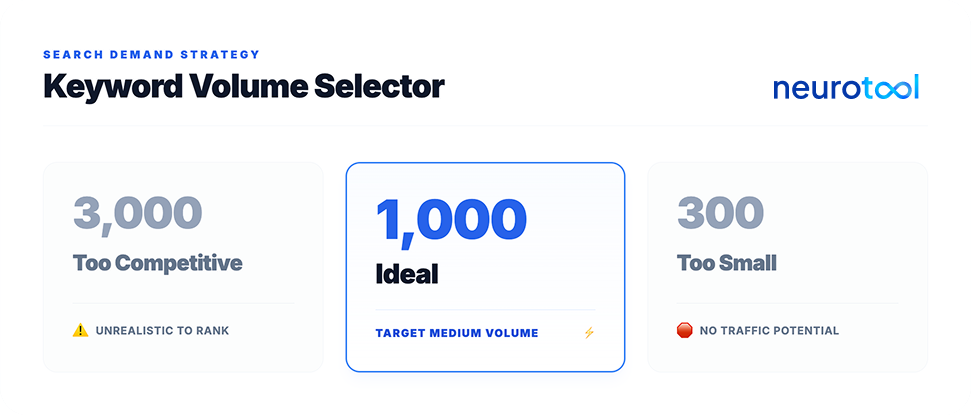
Now for an important detail we’ve worked out through practice: we don’t go for the highest-volume queries. Those have the most content already written for them — competition is at its peak, and the chance of ranking #1 is minimal. Especially for a new website.
We also don’t go for zero or extremely low-volume queries — there’s simply no traffic there.
We go for medium-volume queries. We check volume and competitiveness for every query through Ahrefs — that gives us exact numbers, not gut feelings.
If you have three options — 3,000, 1,000, and 300 searches a month — we go with 1,000. Enough demand, significantly less competition. That’s exactly where you can realistically claim a leading position before you have the authority of an established domain.
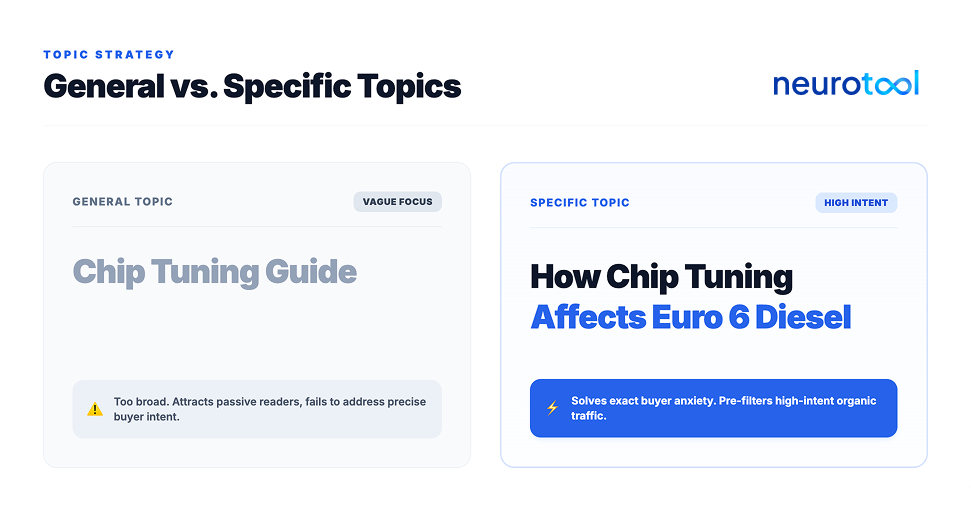
The second principle is depth, not breadth. According to SEO Sherpa, B2B companies that publish 9+ pieces a month get 20.1% more traffic. But only if the articles are written for specific queries — not general topics.
Not “an overview of chip tuning” — but “how chip tuning affects the lifespan of a Euro 6 diesel engine.” Not “how to choose a CRM” — but “CRM for SaaS startups under 50 people: comparing HubSpot and Pipedrive by total cost of ownership.”
Overview articles are needed too — especially if your niche doesn’t have them yet. The strategy is: cover the key overview topics first, then go deeper. Or alternate: one overview piece, one in-depth piece.
A keyword core with volume data isn’t a list of words. It’s prioritization: what to write first, what second, where you have a shot at quick results.
Step 3 — Topic Generation: From Data to Specifics
By this point we have three sources: the competitor article analysis, the target audience document, and the keyword core with volume data. Plus basic company information. All of this gets loaded into AI — and we generate 50–60 topics. The keyword core has already been built through Ahrefs by this point with real volume data — the AI receives more than just a topic, it receives data: queries, volumes, competitiveness.
We don’t just ask for a list. We set parameters: topics must solve an audience pain point, answer a real search query, cover different stages of the funnel, and include different formats — how-tos, comparisons, lists of mistakes, guides.
A separate requirement is specificity in the phrasing. Not “How to choose X” — that’s too vague. Instead:
“5 mistakes when choosing X that are costing you money”
“X vs Y: which is better for [specific situation]”
“Step-by-step guide to Z in [specific timeframe]”
And a mandatory condition: every topic has the target keyword built into it. Not in parentheses, not tacked on at the end after a dash — organically, as part of a natural headline.
From the GAN content plan: “Tuning Box vs ECU Remapping: Which Method is Safer for Your Engine in 2025,” “Stage 1 vs Stage 2 vs Stage 3 Tuning: Complete 2025 Decision Guide.” Every topic is already almost a finished H1, with the keyword built in and a clear promise to the reader.
After generation, the list is checked manually: we remove semantic duplicates, verify coverage of all three funnel stages, and make sure there are no topics outside the client’s area of expertise. That’s exactly what Google penalizes for — and exactly what killed HubSpot.
Topics are handled. Now the most important part — turning them into actual technical briefs.
Step 4 — From Topics to a Full Content Plan
A list of topics isn’t a content plan yet. It’s raw material.
A topic requires interpretation: every writer will read it differently and write something different. A content plan is a technical brief that lets you write the article without a single follow-up question. The difference is whether you end up with 20 consistent pieces or 20 articles from 20 different people.
For every topic, we fill in six fields. Here’s an adapted version of the prompt we use:
Prompt for building a content plan:
Based on the list of topics and the keyword core, create a content plan. For each topic, fill in:
- Meta-title (60–70 characters) — Primary keyword at the start — Specificity or a number — USP if it fits Example: “Tuning Box vs ECU Remapping: Which Is Safer for Your Engine in 2025”
- Meta-description (140–155 characters) — USP — Numbers — Call to action Example: “Complete comparison of tuning boxes vs ECU remapping. Warranty impact, reversibility, safety. Find out which method protects your engine — and your dealer warranty.”
- SEO H1 — With the primary keyword woven in organically, not mechanically — Specificity, numbers, or a question — Keyword not in parentheses, not tacked on at the end after a dash ✅ “Stage 1 vs Stage 2 vs Stage 3 Tuning: Complete 2025 Decision Guide” ❌ “Car Tuning (stage 1 stage 2 stage 3)”
- Primary keyword The main query for this article from the keyword core
- 5–7 secondary keywords Relevant queries from the keyword core that fit naturally into the article
- Basic article structure — A quick answer to the main question (1 paragraph) — 3–5 supporting points developing the topic — Format depends on article type: comparison, how-to, list of mistakes, guide — FAQ (4–5 questions) — CTA
Output format: a table or structured list. Each topic as a separate block.
Of the six fields, the article structure is the most important. Not the meta tags, not the keywords. The structure is what determines whether the article will answer the search intent — or just contain the right words. Meta tags affect CTR. Structure affects whether the reader stays on the page.
Here’s how this looks in a real example from the GAN content plan:
Topic: Tuning Box vs ECU Remapping: Which Method is Safer for Your Engine in 2025
Primary keyword: tuning box vs remap
Secondary keywords: ECU remap vs chip, hardware vs software tuning, safe engine tuning, reversible tuning, is tuning box better than remap
Structure:
- Quick answer: the fundamental difference (1 paragraph)
- How ECU remapping works (permanent changes to factory code)
- How a tuning box works (external signal correction)
- Warranty implications: why a box preserves coverage
- Reversibility: one button vs $500 at the dealer
- Detectability during diagnostics
- 5-year cost analysis
- CTA
This is no longer a topic. It’s a finished plan for a writer or an AI to work from — no guesswork, no extra calls needed. The final content plan is saved in a Google Sheet: each row is one article, every field filled in, the whole team working off a single document.
Why Breaking the Order Costs More Than a Bad Article
You can go through all four steps correctly — and still get a bad result. If you don’t do them in the right order.
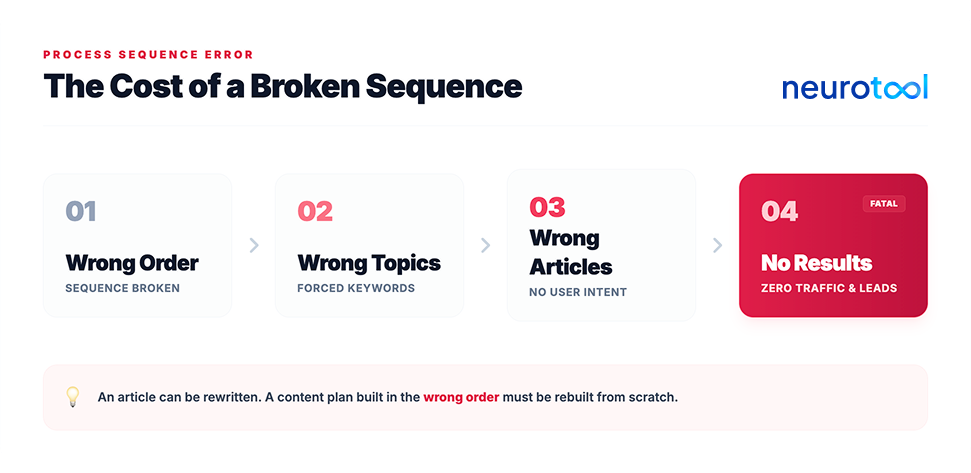
The most common mistake: topics get generated before the keyword work. The team comes up with what to write about, then tries to “force-fit” keywords onto the finished topics. The resulting content looks logical, but doesn’t match what the audience is actually searching for. The articles exist. The traffic doesn’t. The cycle closes.
The second typical failure: audience analysis exists separately from the content plan. You know who your reader is — but that knowledge doesn’t influence the choice of topics or the structure of the articles. Traffic comes in. Conversions don’t. Because the article was written for a search bot, not for a person with a specific pain point.
According to The Growth Syndicate, 83% of B2B buyers form their purchase requirements before their first conversation with a salesperson. This means your content plan is your first salesperson. It either reaches the right person at the right moment with the right answer — or it doesn’t. There’s no third option.
We’ve confirmed this across hundreds of client projects: breaking the sequence costs more than a poorly written article. An article can be rewritten. A content plan built in the wrong order can only be rebuilt from scratch.
One last thing. A content plan isn’t a document set in stone for a year ahead. After the first 2–3 months of publishing, traffic data will show you what’s working and what isn’t. Good plans get updated. That’s exactly how they get better.
Conclusion
A content plan isn’t a spreadsheet of topics. It’s a system that determines whether your content functions as a tool for attracting customers or just piles up in a blog.
The correct sequence: competitor analysis → keyword core → topics built from keywords → a full content plan with meta data and structure for every article. Working with Ahrefs data at every stage — from competitor analysis to the final keyword core — is what separates a plan built on real demand from a plan built on assumptions.
Breaking this order is the most expensive mistake in content marketing. Not because we say so — but because that’s exactly what cost HubSpot 80% of its traffic.
At Neurotool, we go through these four steps with every client before a single article gets written. A well-built plan makes every following article better than the last. That’s how content that actually grows actually works.
Sources
SEO Sherpa — B2B SEO Statistics 2026 — https://seosherpa.com/b2b-seo-statistics/
The Growth Syndicate — B2B SEO Strategy: The Complete Guide for 2026 — https://www.thegrowthsyndicate.com/resources/b2b-seo-strategy-2026
Omniscient Digital — 60 B2B SEO Statistics to Shape Your Strategy — https://beomniscient.com/blog/b2b-seo-statistics/
Frequently Asked Questions
About the Authors
This article was written by Neurotool copywriters: a team that has produced 1,000+ articles across 18+ industries since April 2025. Each writer works with our proprietary 15-agent AI system, which handles research and analysis at a scale no manual process can match.
The copywriters make every editorial decision: competitor and audience analysis, structure, SEO + GEO optimization, and final fact-checking. AI speeds up the work; humans control quality at every stage.
Learn more about how our technology works →
Start with One Test Article
A full article, completely free. No card, no contract.
- Ready from 24 hours — fast results
- Live copywriters review every word
- 2-3 revision 2-3 revision rounds included free
- Convenient platform Convenient platform for ordering and communication