
The “Company Information” Document: Why Without It, AI Doesn’t Write About You
You gave AI everything: your website, your product, your keywords. It wrote about a company that doesn't exist. And that's not a bug — it's how AI works by default.
- 95% of companies have brand guidelines — but only 25–30% actually use them when producing content
- AI doesn't read your website — it generates what's statistically likely for your niche
- The company information document is the first step of onboarding, and without it, every other document gets built on assumptions
- A USP can't be extracted from a company description in a vacuum — it only emerges through comparison with competitors
- If a client has no website, that's not a dead end. It's a different protocol
The “Company Information” document is a structured document with the key facts about a business: what it does, who founded it, what products it offers, the numbers, the USP, and how it’s positioned against competitors. It’s created first — before audience analysis, before Tone of Voice, before the content plan — and forms the foundation for every other document. Without it, AI fills in the gaps with statistically likely data from its training, not facts about your business.
The Article Is Ready. The Client Reads It. And Says: This Isn’t About Us
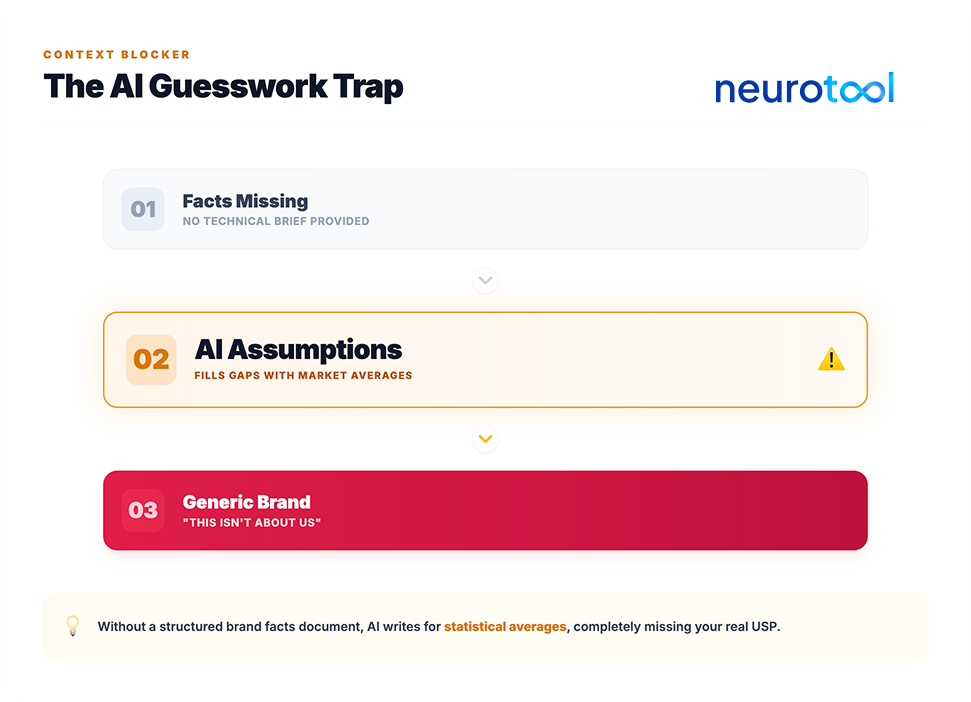
We hear this phrase regularly. The client sends a landing page link, the AI writes an article — polished, optimized, with the right keywords. The client reads it. And says exactly that.
Because it’s true.
AI doesn’t analyze a website the way a human does. It treats it as one of many signals — and fills in the rest with what’s statistically likely for companies in that category. Without a structured document, every article starts from guesswork: what’s your tone, what makes you different, what actually matters to your audience.
Most companies already have brand guidelines somewhere — a style doc, a deck from three years ago, a few rules a marketing lead wrote down once. The problem isn’t that the guidelines don’t exist. It’s that they sit in a folder, not in the AI’s context. The model works with what it’s given, not with what’s sitting somewhere in Google Drive.
The company information document isn’t a “what we do” description for an About page. It’s a technical brief for AI: here are the facts, here are the numbers, here’s what sets us apart — write from this, not from market averages.
At Neurotool, we create this document first during every client’s onboarding. Without it, the audience analysis, the Tone of Voice, and the content plan are all built on assumptions — not on the facts of a specific business.
But before creating the document, you need to understand where the material comes from.
Three Sources — and What Each One Gives You
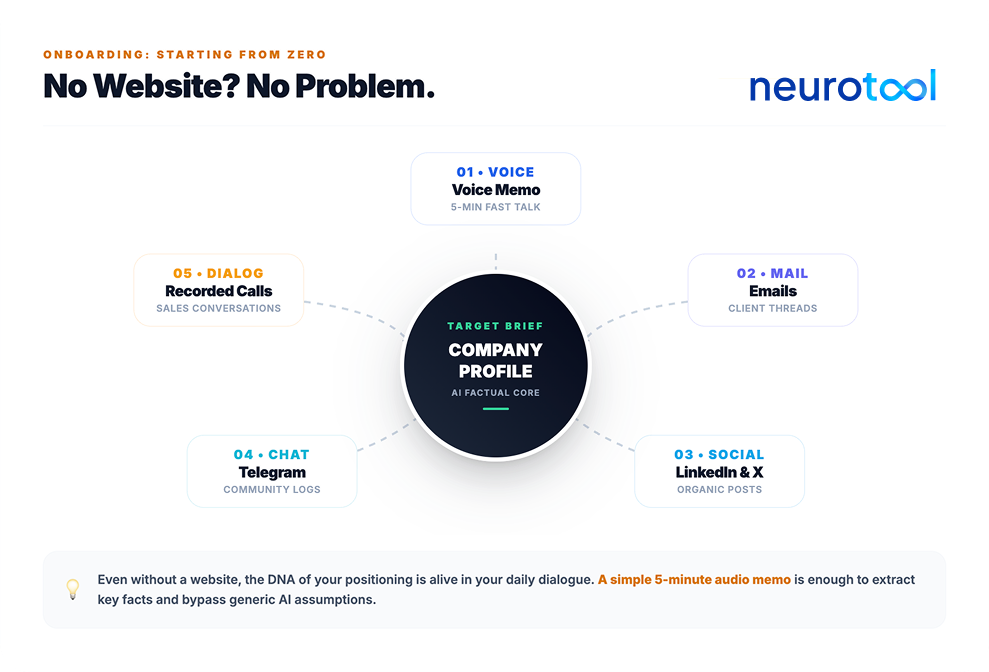
Three sources — and each gives a different type of information. Skip any one of them, and you get a document with gaps.
The client’s landing page. The primary source of facts: what the company does, what products it has, the numbers the client considers important. We take both the link itself and the copied text separately — AI works more reliably when the data is already in context, rather than requiring separate parsing.
Competitors. Copy from the websites of 3–5 players in the niche. Not to copy it — but to use the contrast to see exactly what the client can claim as their own. More on this in the next section, where we explain why a real USP only emerges through competitors.
Any other materials. Blog articles, social media posts, case studies, customer reviews. Anything where the company has already spoken in its own voice.
What if the client has nothing at all? No website, no blog, no social media. This happens more often than you’d think — especially with new projects.
In that case, we ask the client to record a voice memo: what they do, what they sell, to whom, what they’re proud of. Five minutes of talking is enough to extract the positioning and key facts. LinkedIn, X, Facebook, Telegram posts, correspondence with clients, a recorded call — anything works as source material.
The business already exists, which means the information exists. The job is to find what format it’s stored in.
Why “We’re Fast and High-Quality” Isn’t a USP
Here’s the counterintuitive point that changes the whole document.
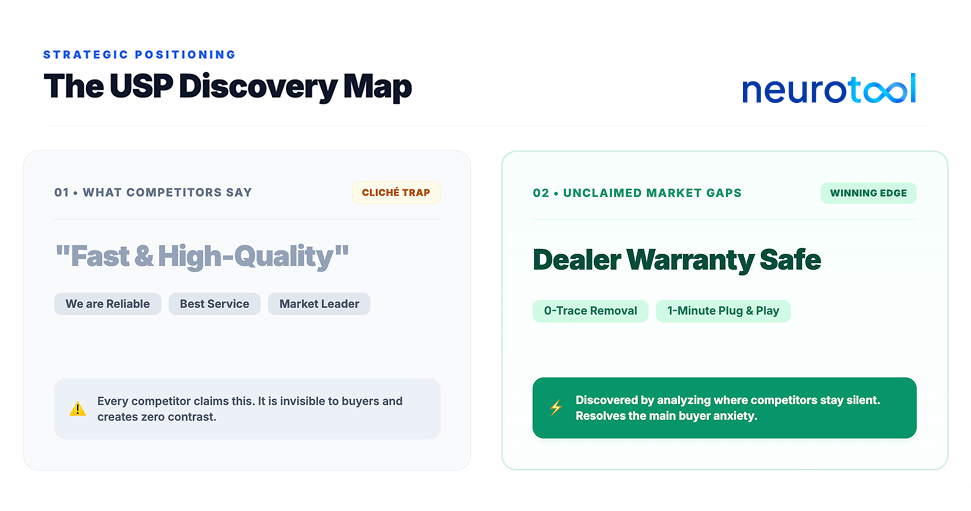
Most teams try to extract the USP directly: “What’s unique about you?” The client answers: “We’re fast, high-quality, and reliable.” Sounds reasonable. But what’s unique about it, if that’s what every other landing page on the market promises too?
A USP isn’t invented — it’s discovered. And it’s discovered only through comparison with competitors.
According to Alm Corp, a unique value proposition is a specific, defensible claim about what your business does better or differently than the available alternatives. It’s impossible to formulate without competitor analysis — there’s simply no point of reference.
Three questions that reveal a real USP:
What do competitors promise that the client stays silent on? This is often an unclaimed position — a potential differentiator sitting right in front of you.
What does the client do that competitors don’t offer? Sometimes it’s technology, sometimes speed, sometimes the format of the work.
Where are competitors weak, based on audience feedback? Pain points the market isn’t addressing — that’s the space for positioning.
In practice, it looked like this. While working on the GAN project — tuning modules for the European market — analyzing competitor landing pages showed that most players sell power and performance, but steer clear of the topic of dealer warranties. That became the central angle: “tuning without losing your warranty.” Not because we invented it — because the competitors themselves showed us where they weren’t addressing the buyer’s main fear.
Nine Sections — and What Each One Gives You When Writing Articles
This isn’t a business description for an “About Us” page. Every section solves a specific problem.
1. Quick overview. Company name, founding date, founders, target segment. Sets context — AI knows who it’s working with instead of guessing.
2. Mission. Philosophy and the key difference from competitors. Shapes the angle for every topic that will appear in articles.
3. What we do. The service or product, specifics, technology, timelines. This is where precise phrasing comes from — not “full-service agency,” but what actually happens inside.
4. USP. A minimum of three sentences with explanation and numbers. The foundation for CTAs, headlines, and benefit blocks in articles.
5. About the team. Founder, experience, achievements. Directly affects E-E-A-T — expertise signals that matter for GEO citation.
6. Clients. How many served, what segment, examples. Social proof that gets woven naturally into the copy.
7. Approach to work. Philosophy, differences from competitors, what we don’t do. Often the most valuable section — this is exactly where what makes the company recognizable is stored.
8. Key numbers. Every number from the landing page: timelines, volumes, percentages, guarantees. Without numbers, the text sounds like a marketing brochure.
9. Contacts. Website, email, messaging apps. A technical necessity for the closing blocks of articles and the CTA.
The optimal length is 2–3 pages. Enough context for AI. Not so long that the key facts get lost.
The Prompt for Creating the Document — Adapt It to Your Needs
Below is an adapted version of the prompt we use during onboarding.
What to attach before running it:
- A link to the client’s landing page
- The text from the landing page (copied separately)
- Landing page copy from 3–5 competitors
- Any additional materials: blog, social media, recorded voice memos
Prompt:
Using all the uploaded materials, create a “Company Information” document. Show the client’s advantages relative to competitors. Extract unique selling propositions through comparison.
Document structure:
- Quick overview — name, founding date, founders, client segment
- Mission — company philosophy, key difference from competitors
- What we do — main service / product, specifics, technology, timelines
- USP — a minimum of 3 sentences with explanation and numbers
- About the team — founder, experience, achievements
- Clients — how many served, segment, examples
- Approach to work — philosophy, differences from competitors, what we don’t do
- Key numbers — all numbers from the landing page
- Contacts — website, email, messaging apps
Write specifically, with facts, with numbers. No generic phrases. Extract the USP through what competitors don’t say or don’t do.
Two things to keep in mind when working with this prompt.
Competitor data is stored separately from client data. Only conclusions about the client’s positioning go into the final document — not quotes from competitors.
Check the USP for specificity: if a section says “high quality” or “personalized approach,” that’s not a USP. A real USP contains either a number, a concrete promise, or a difference from what competitors do.
Why This Document Is the Foundation, Not Just One File Among Many
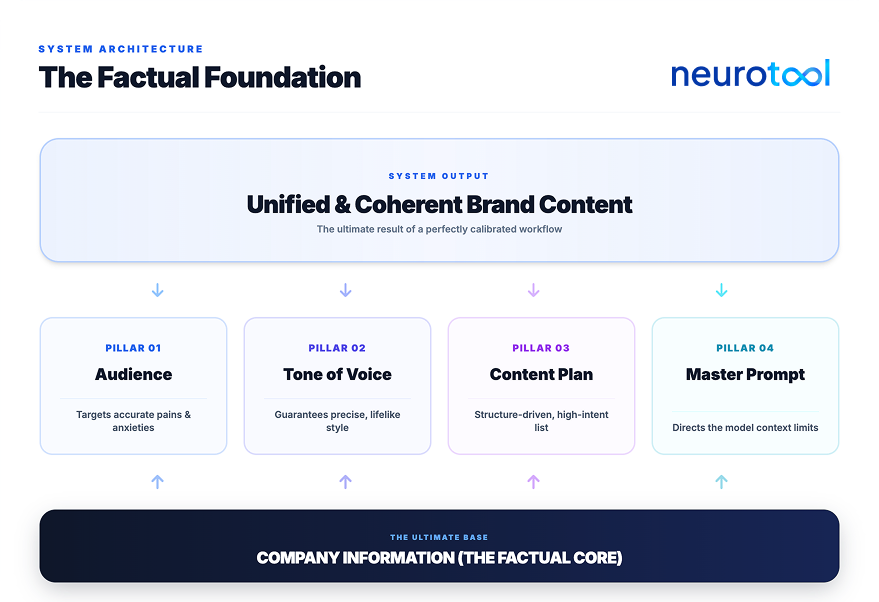
Here’s where most people go wrong: the company information document gets treated as just another onboarding checkbox. Done — check it off.
In reality, it’s the foundation everything else rests on.
The USP from section four carries over into the master prompt as the basis for CTAs and headlines. The philosophy from section two shapes the angle in the Tone of Voice. The audience portrait from the quick overview becomes the starting point for the audience analysis. The key numbers show up in articles as the concrete detail that distinguishes the text from marketing noise.
If you create these documents in parallel or in a different order, they won’t directly contradict each other — but they lose coherence. Each one ends up built on its own assumptions instead of a single factual foundation.
After reviewing hundreds of client projects, we see one consistent pattern: teams that skip this step or do it as a formality get content that technically meets the requirements but doesn’t sound like a specific company. The reader feels it. They can’t always articulate what’s wrong — but they leave.
The document lives in the system as permanent context — AI receives it for every task, instead of guessing the facts all over again.
Conclusion
The company information document isn’t an onboarding formality. It’s the technical foundation that determines whether all the content that follows will sound like a specific business or like an average player in the niche.
The correct sequence: gather the landing page + competitors → extract the USP through comparison → structure it into nine sections → load it into the project as permanent context. Only after that — audience analysis, ToV, content plan, master prompt.
At Neurotool, we create this document first in every onboarding — because everything written afterward rests on it.
Sources
Alm Corp — Competitive Analysis Guide: Outsmart Your Competition in 2026 — https://almcorp.com/blog/competitive-analysis-guide/
Envive — 40 Brand Voice Consistency Statistics in eCommerce in 2026 — https://www.envive.ai/post/brand-voice-consistency-statistics-in-ecommerce
Frequently Asked Questions
About the Authors
This article was written by Neurotool copywriters: a team that has produced 1,000+ articles across 18+ industries since April 2025. Each writer works with our proprietary 15-agent AI system, which handles research and analysis at a scale no manual process can match.
The copywriters make every editorial decision: competitor and audience analysis, structure, SEO + GEO optimization, and final fact-checking. AI speeds up the work; humans control quality at every stage.
Learn more about how our technology works →
Start with One Test Article
A full article, completely free. No card, no contract.
- Ready from 24 hours — fast results
- Live copywriters review every word
- 2-3 revision 2-3 revision rounds included free
- Convenient platform Convenient platform for ordering and communication