
AI Content Uniqueness: Why One Prompt Doesn’t Work
AI doesn't steal other people's text. But that doesn't mean your content is unique.
- 94% of marketers plan to use AI for content in 2026, according to Averi — and most get variations of the same industry-average answer
- The same AI tool with the same prompt produces a different result if you change not the prompt, but the knowledge base
- A client's YouTube channel, internal documents, and social media posts are hundreds of pages of original content their competitors don't have. Most agencies simply ignore it
- Google doesn't penalize AI. Google penalizes content with no original contribution, and the difference is visible immediately once you change the source AI is writing from
The uniqueness of AI content isn’t about a match percentage in a plagiarism checker. It’s about whether your content reflects real company expertise, voice, and positioning, or simply reproduces the industry average. When AI writes from the internet’s global database, the result is statistically likely for your niche. A personal knowledge base built from your own materials changes the source, and that’s what changes the result.
The Real Problem Isn’t AI — It’s the Knowledge Base It Writes From
Here’s what almost every client who comes to us after six months of working with AI on their own runs into: they have articles, they have traffic, they have no leads. They start looking for the problem in SEO. They change keywords, rewrite meta tags. Nothing changes.
The problem isn’t the optimization. The problem is that anyone could have written this content.
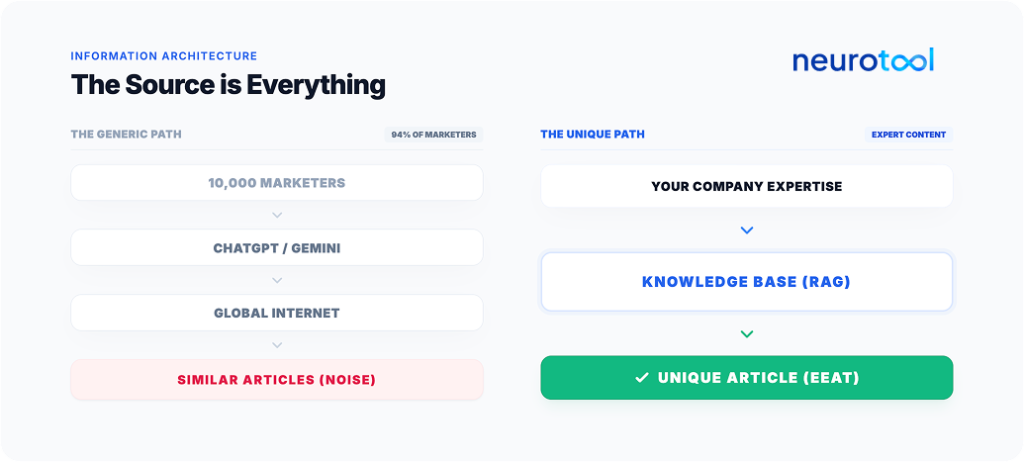
Picture this: 10,000 marketers open ChatGPT and type in roughly the same prompt about your niche. How different will those articles actually be? According to Averi’s State of AI in Marketing 2026, 94% of marketers plan to use AI to create content. All of them are pulling from the same source: the global internet. The result is statistically optimal for the topic. But not for your company.
What do you think marketers complain about most in AI content? Factual errors? Bad writing? According to a Brafton survey of 132 marketers, the number one complaint is something else entirely. 87 of them named content that sounds too generic and impersonal as the main problem, by a wide margin over everything else. The issue isn’t that AI writes badly. The issue is that it writes the same way for everyone.
You can rewrite the prompt a hundred times. The result is just variations on the same industry-average answer. Because the prompt doesn’t change the source. And the source is everything.
The solution isn’t a better prompt. The solution is a different knowledge base.
What a Personal Knowledge Base Is — and Why It’s Not the Same as “Uploading a File to ChatGPT”
A standard LLM pulls from billions of internet sources. A personal knowledge base pulls from one: your own materials. At Neurotool, we call this our RAG system.
Here’s a more precise definition.
RAG (Retrieval-Augmented Generation) isn’t an exotic technology. According to IBM, it’s an architecture that lets AI models draw on external knowledge bases: a company’s internal documentation, specialized data, proprietary information. Every language model is already working with some kind of base — the only question is which one.
You can read more about this in our article “Why AI Doesn’t Write About You — and How a Personal Knowledge Base Fixes That.”
Here’s the analogy that describes it most precisely. You hire a brilliant consultant. They know the industry, write well, structure their thoughts clearly. But it’s their first day on the job. They haven’t read a single one of your case studies, haven’t watched your YouTube videos where you explain your methodology, don’t know what actually sets you apart from your competitors. They’ll write a competent piece of text. About an abstract company in your niche.
Now give them all of your documents. Recordings of client calls. Every blog post. Every video. Same person, fundamentally different result.
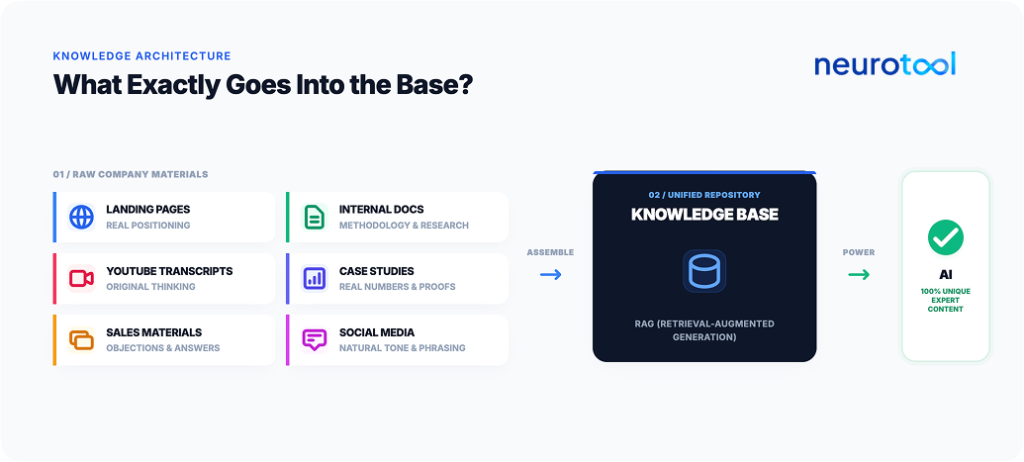
At Neurotool, we build this base from whatever the client already has: landing pages, sales materials, internal documents, YouTube transcripts, LinkedIn and other social media posts, case studies. AI then writes exclusively from that source. It contains insights that don’t exist anywhere else online. That’s exactly why they can’t be reproduced, even with the same tool and the same prompt.
But the knowledge base is only half the process.
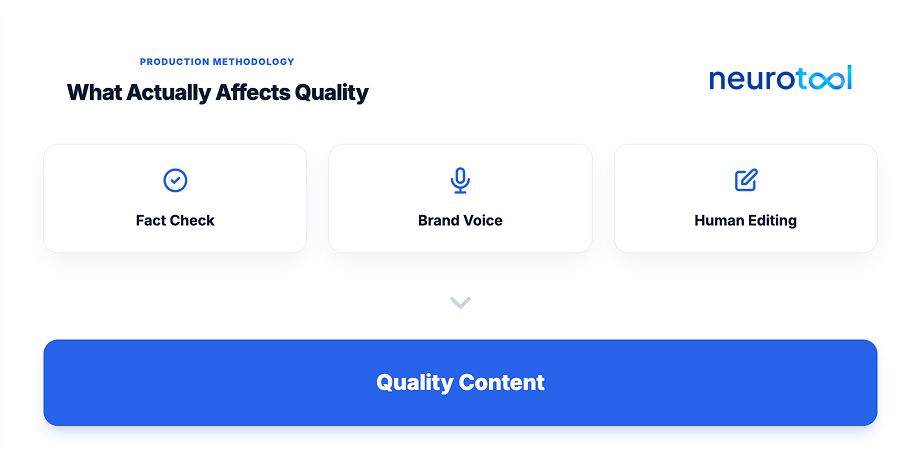
Before writing an article, we take one more step: we gather research on the topic. Not general facts pulled from the model’s memory, but current data. We turn to research published by major companies that have already published their findings, and check which figures are currently accurate. This isn’t a premium-package add-on, it’s part of the process for every single article.
Without this research, AI fills the gaps with whatever sounds plausible, which might be outdated or entirely made up. With the research, the article ends up containing facts that can actually be verified.
What Exactly Goes Into the Base — and Why Every Type of Material Matters
This isn’t the most exciting part of the conversation. But it’s exactly where whether the content ends up unique or not gets decided.
Landing pages and sales materials. This is where your real positioning lives, not the one you’d like to project, but the one that’s already working. The objections you address. The language your sales team actually uses with clients. Standard AI doesn’t see any of this. It writes about “your product” the way products in general get written about.
Internal documents. Most companies are sitting on a gold mine and don’t know it. Proprietary research, methodology documents, case studies with real numbers, this is content competitors simply don’t have. When AI writes from it, the text ends up containing insights that no prompt could reproduce.
YouTube transcripts. One of the most underrated sources. If the founder or team has recorded explanations of their methodology, answered client questions on video, that’s hundreds of pages of original thinking. We transcribe it and load it into the base. AI then writes the way you actually talk, not the way your industry usually writes.
Social media posts. This is where the tone lives. The way you phrase problems, the words you gravitate toward, the topics you care about. This is exactly what helps AI land your voice at a granular level, not “a professional tone,” but specifically yours.
After dozens of projects, the pattern is clear: the richer the knowledge base, the more unique the content. A competitor with the same tool and the same prompt will get a different result, because they don’t have your documents. That’s real uniqueness, not textual, but structural.
What Actually Changes — and Why It Affects Rankings
Three things. Specifically.
First — the content stops sounding like your niche and starts sounding like your company. This is harder to quantify than you’d like. But it’s immediately audible to anyone who knows your brand. Clients who work with us often say the same thing: “This actually sounds like us.” Not “not bad,” not “kind of like us.” Specifically: like us.
Second — structural originality. When AI pulls from your internal materials, it doesn’t copy the information architecture of competitors’ top-ranking pages. A different angle, because a different source. A reader who’s already read three articles on the topic will feel the difference immediately.
Third — rankings. According to CEOWORLD, Google updated its Quality Rater Guidelines in 2025 specifically to target low-effort AI content: pages with no original contribution receive a low-quality rating regardless of how they were produced. And here’s what matters: losing visibility in search coincides with losing citability in ChatGPT and Perplexity, because those systems rely on sources that already have search authority.
Generic content, content that mirrors what’s already online, doesn’t pass this test. Content with real insights from real materials does. This isn’t theory. The articles that perform best in search and AI citations are the ones that contain something that genuinely doesn’t exist anywhere else. A specific number. A methodology explained in its own way. A case study with real figures. This doesn’t come from prompts. It comes from the knowledge base.
Detectors Measure Uniqueness. But That’s Not What Decides an Article’s Fate
It’s worth addressing uniqueness detectors directly here, because we get asked about them often.
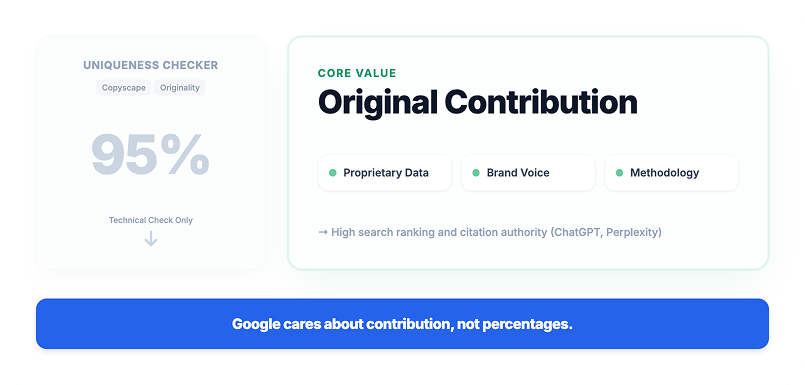
Every uniqueness-checking service, Copyscape, Content at Scale, Originality.ai, uses its own algorithm and its own comparison database. The same exact text can show 95% uniqueness in one tool and 78% in another. According to the Chicago Booth Review (2025), AI content detectors show inconsistent reliability and aren’t suited as the sole basis for decision-making, they should be used only as one signal, not as a verdict.
We don’t ignore these tools. But we also don’t treat “100% uniqueness” as equivalent to “a good article.”
Because the opposite happens just as often: a text with 100% uniqueness according to a detector can still be useless, generic phrases, no substance, no point of view. And a text with 85% uniqueness can genuinely answer the reader’s question better than any other article in the search results.
As Search Engine Land puts it, what matters isn’t whether the text was written by AI or a human — what matters is whether it helps people solve their problem and offers unique value. Google’s algorithms are built to find exactly that, not a percentage match against other text on the internet.
That’s why our sequence works like this: research on the topic first, then writing from the client’s personal knowledge base, and only at the end, a check through a uniqueness detector as one checkpoint before publication, not as the final quality criterion.
Conclusion
The problem with AI content in 2026 isn’t the quality of the tools. The tools have become good enough. The problem is that almost everyone is using the same tools with similar prompts pulling from the same global pool of knowledge, and getting similar results.
The solution has two parts, and both need to work together. A personal knowledge base gives AI a source no one else has: your documents, your voice, your case studies. Up-to-date research before writing gives the article verifiable facts instead of whatever AI plausibly invents from general knowledge.
A uniqueness detector has nothing to do with any of this; it measures something else entirely. Real content uniqueness doesn’t come from a percentage in a checking tool. It comes from the source AI is pulling facts from, and how deeply it’s grounded in those facts.
Here’s what ultimately separates content that works from content anyone could have written: not a number from a detector, but what’s actually behind the text.
Sources
- Brafton — The 4 Biggest Challenges in AI Content Creation in 2026 (June 2026) — https://www.brafton.com/blog/content-marketing/the-4-biggest-challenges-in-ai-content-creation/
- IBM — What is RAG (Retrieval Augmented Generation)? (2026) — https://www.ibm.com/think/topics/retrieval-augmented-generation
- CEOWORLD magazine — AI Content Is a Real Brand Risk (May 2026) — https://ceoworld.biz/2026/05/21/ai-content-is-a-real-brand-risk-smart-executives-are-already-one-step-ahead/
- Averi — State of AI in Marketing 2026 (March 2026) — https://www.averi.ai/blog/the-state-of-ai-content-marketing-2026-benchmarks-report
- Chicago Booth Review — Do AI Detectors Work Well Enough to Trust? (2025) — https://www.chicagobooth.edu/review/2025/december/do-ai-detectors-work-well-enough-trust
- Search Engine Land — How to Detect AI-Written Content & Plagiarism Accurately (2026) — https://searchengineland.com/guide/detect-ai-content-prevent-plagiarism
Frequently Asked Questions
About the Authors
This article was written by Neurotool copywriters: a team that has produced 1,000+ articles across 18+ industries since April 2025. Each writer works with our proprietary 15-agent AI system, which handles research and analysis at a scale no manual process can match.
The copywriters make every editorial decision: competitor and audience analysis, structure, SEO + GEO optimization, and final fact-checking. AI speeds up the work; humans control quality at every stage.
Learn more about how our technology works →
Start with One Test Article
A full article, completely free. No card, no contract.
- Ready from 24 hours — fast results
- Live copywriters review every word
- 2-3 revision 2-3 revision rounds included free
- Convenient platform Convenient platform for ordering and communication