
Master Prompt for Writing SEO Articles: How We Built a System That Works Without a Brief
One prompt replaces a brief, an editor, and a style guide at the same time. If it's built correctly.
- Structured prompts reduce AI errors by 76% — but only if they contain the right elements
- A role and persona in a prompt improve tone and style — but not factual accuracy. Those are separate tasks
- Without a "what's forbidden" section, a prompt falls apart at scale
- A single master prompt replaces a brief for every article — if it's built correctly
- 68% of companies train employees on prompt writing — and most stop at a basic level
A master prompt for writing articles is a structured, standing instruction for AI that combines company context, SEO and GEO rules, Tone of Voice, and a list of prohibitions in a single document. Unlike a one-off prompt, it gets attached to every new article and delivers a consistent result without repeated explanations. According to TechRT’s 2026 data, structured prompts reduce AI output errors by 76% compared to unstructured queries.
“Write an Article” Isn’t a Prompt. Here’s How That Ends
A familiar situation: a team writes a prompt — “Write an SEO article about X in a friendly tone, 2,000 words, with keyword Y.” The first article comes out fine. The fifth is already different. The tenth is different again. By the twentieth, the whole blog sounds like it was written by different people in different moods.
The first instinct is to improve the text itself. Hire an editor. Add more detail to the brief. But that’s not where the problem is.
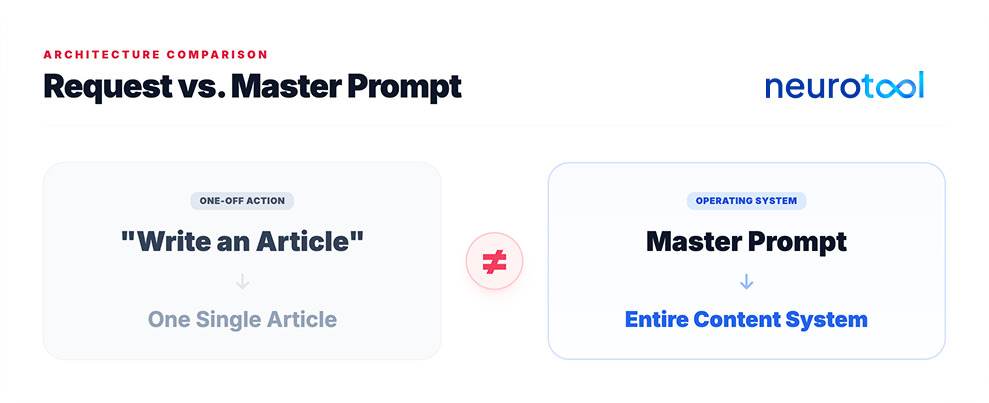
“Write an article about X” is a request. Not a prompt. AI executes it differently every time, because it doesn’t know: who you are, who you’re writing for, what words are off-limits for you, and what “friendly tone” actually means for your specific brand. Every article is guesswork from scratch.
A master prompt solves a different problem. It’s not an instruction for a specific article — it’s an operating system for the entire content production process. It gets attached to every new piece and doesn’t change. Only the brief for the specific topic changes — everything else is already built in.
According to MIT research, access to AI cut writing time by 40% and improved output quality by 18% on professional writing tasks. The catch: those gains showed up on tasks that didn’t require deep company-specific context — which is exactly the gap a master prompt is built to close.
At Neurotool, we use a master prompt for every article we write, and it starts from the position that the AI already knows everything about the company, the audience, and the rules.
But here’s what matters: the master prompt isn’t the first step. You need to gather the data first.
What You Need Before You Open a Blank Document
The most common mistake is sitting down to write a prompt without source data. What comes out is something like “write professionally, but not boring.” AI interprets that however it wants. And differently every time.
Three things without which a prompt is just an empty container:
Company information. What it does, what products it has, the key USPs, positioning relative to competitors. Without this, AI writes for an abstract company pulled out of thin air — polished, but about nothing in particular.
Target audience analysis. Who’s reading, what their pains are, what level of expertise they have, what objections need to be addressed directly in the text. Without this, AI writes for everyone — which means for no one in particular.
Tone of Voice. Not “friendly and professional,” but specific phrasings, characteristic expressions, banned words, formality level on a scale. Without this, AI reverts to a default corporate template after three articles.
The master prompt is the packaging of everything already gathered into a single instruction. Not writing from scratch — assembly.
Once you have the data, you can start building the architecture.
Five Sections That Make Up the Master Prompt
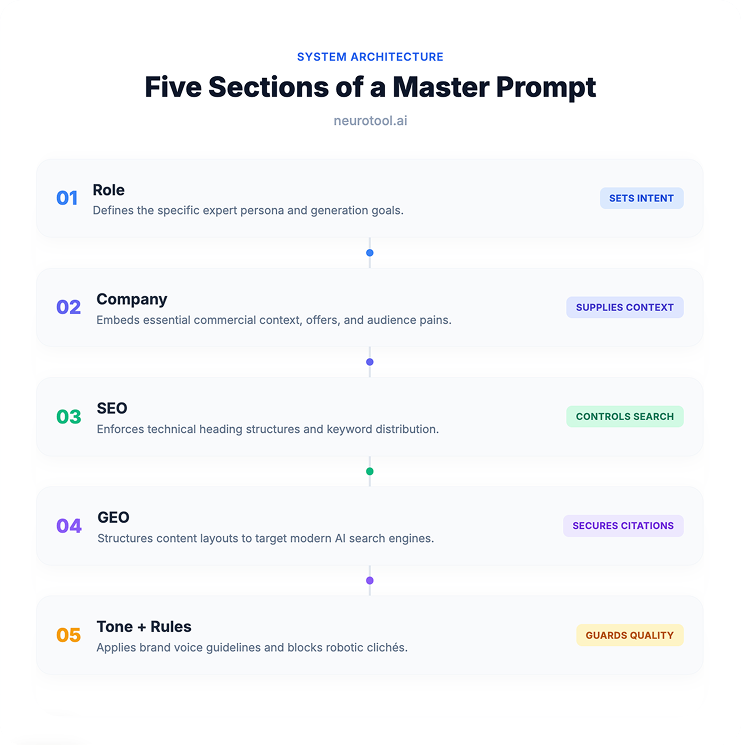
This isn’t one long piece of text. It’s a system of five sections, each solving a separate task. Remove any one of them, and the system starts breaking down.
Section 1: Task and role. AI receives its top priority and an understanding of who it’s writing for. Not “write an article,” but a specific instruction: who the author is, who the reader is, what matters most in the result.
Example: “You are a senior copywriter for [company name]. You write for real people with real problems. The first priority is text that’s interesting to read and that gives the reader something concrete to take away. The second priority is SEO and GEO optimization.”
An important nuance about the role: research from The Register in 2026 confirms that a role-persona improves results for writing and style tasks. For factual accuracy, it doesn’t. That’s exactly why fact-checking is handled as a separate section rather than replaced by an “expert persona.”
Section 2: Company context. Brief but specific information: what the company does, key services, USP, target market. Plus a distillation of the audience analysis: pains, desires, decision-making behavior.
Example: “[Name] is a B2B content marketing agency. Key facts: [services], [pricing], [speed], [guarantees]. Audience: CMOs, SEO agency owners, SaaS founders. They value specifics and honesty. They don’t tolerate fluff.”
Section 3: SEO rules. Specific technical requirements: primary keyword density (3–5 times per 1,000 words), LSI keywords (8–12 occurrences spread evenly), heading structure (H1 with the primary keyword, an H2 every 300–400 words), meta data, internal linking.
Without this section, AI writes good text that ranks poorly. With it, SEO is built into the structure starting with the first draft.
Section 4: GEO rules. GEO is optimization for citation in AI search: ChatGPT, Perplexity, Google AI Overviews. The structure differs from classic SEO.
What we include: a direct answer to the main question in the first paragraph under every H2, definitions of terms immediately after they’re first mentioned, clearly structured lists, specific sourcing (“according to [source],” not “studies show”), E-E-A-T — experience, expertise, authoritativeness, trustworthiness.
Section 5: Tone of Voice + prohibitions. A distillation of the ToV document: formality level, characteristic phrasings, the brand voice’s signature markers. And the list of prohibitions — the most important part. More on that separately below.
The optimal length for a finished prompt is 3–4 pages. Shorter, and AI doesn’t get enough context. Longer, and it loses focus on the specific instructions.
Master Prompt Template — Adapt It to Your Needs
A working structure to get started. Plug in your project’s data, and the prompt is ready for the first article.
MASTER PROMPT FOR WRITING ARTICLES — [COMPANY NAME]
1. TASK AND ROLE
You are a senior copywriter for [company name]. You write for [audience description: job title, industry, main pain point].
The first priority is text that’s interesting to read, with reliable information and real value.
The second priority is SEO and GEO optimization. These get woven organically into quality text, not the other way around.
2. COMPANY CONTEXT
[Name] is [one sentence about what the company does].
Key facts: [services / products], [pricing], [speed / timelines], [guarantees].
Target audience: [job title], [company size], [main pain point], [what they value, what they don’t tolerate].
Market: [geography]. All examples must come only from this context.
3. SEO RULES
— Primary keyword: 3–5 times per 1,000 words, organically — LSI keywords: 8–12 occurrences, spread evenly — H1: one, with the primary keyword — H2: every 300–400 words, 50% containing keywords — Meta-title: 60–70 characters, keyword at the start — Meta-description: 140–155 characters, USP + numbers + call to action — Internal linking: 2–3 links
4. GEO RULES
— A direct answer to the main question in the first paragraph under every H2 — Definitions of terms immediately after their first mention — Clearly structured lists — Sourcing: “according to [source],” not “studies show” — E-E-A-T: personal experience, case studies with numbers, links to authoritative sources — A 40–60 word GEO block right after the H1
5. TONE OF VOICE + PROHIBITIONS
Style: [formality level on a 1–10 scale]. [One sentence on the character of the brand voice].
Characteristic expressions: [2–3 real examples from the client’s materials]
FORBIDDEN: — AI clichés: [list of specific words and phrases] — Empty phrases: [list] — Overpromising: [list]
Every conclusion is written from the perspective of the [name] team, not neutrally. “In our experience…,” “We’ve tested this across [X] projects…”
Two things to keep in mind when working with this template.
Fill in the prohibitions section from real drafts — not off the top of your head. Take the last 5–10 pieces that required edits. That’s where you’ll find the exact words you need.
The “Tone of Voice” in the prompt isn’t a copy of your full ToV document. It’s a short distillation: the most characteristic expressions and the most important prohibitions. The full document is kept separately.
Why Prohibitions Work Better Than Requirements
Here’s something we didn’t understand right away — and it’s what improved our article quality fastest once we did.
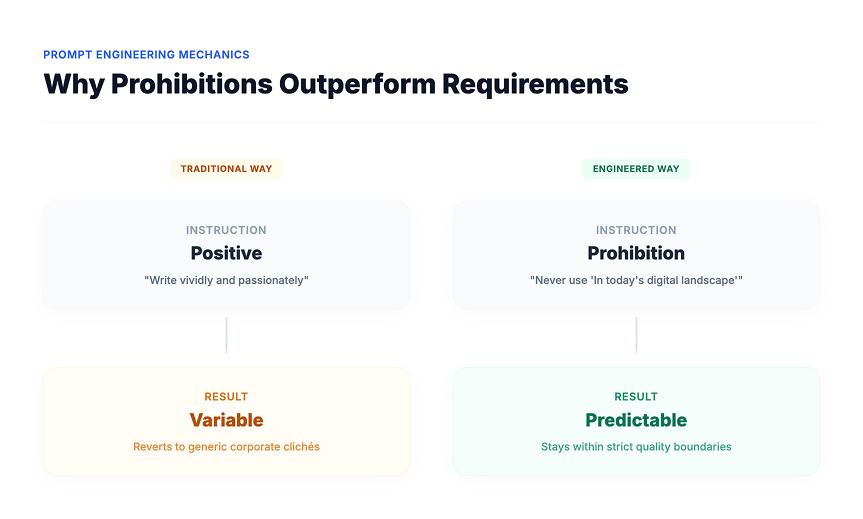
“Write vividly and specifically” is a wish. AI hears it, nods, and three paragraphs later produces “In today’s fast-paced digital landscape.” “Never use ‘In today’s digital landscape,’ ‘leverage,’ ‘game-changer,’ ‘seamless'” is a prohibition. AI follows it precisely.
AI follows constraints more easily than it follows positive descriptions. That’s not a bug — it’s a property of language models. A clear boundary of “this isn’t allowed” produces a more predictable result than a vague “write like this.”
Our list of prohibitions grew out of real drafts, not theory. The first versions of articles came back with editor’s notes where the same words were underlined again and again. We collected them, organized them, and built them into the prompt.
Three categories in every one of our master prompts:
AI clichés. Words that instantly give away neural-network-generated text: “delve into,” “unlock,” “revolutionize,” “navigating the complexities,” “harness the power of.” A complete ban, no exceptions.
Empty phrases. “It’s important to note,” “it should be emphasized,” “the significance cannot be underestimated.” They carry no information — they just pad the word count. We cut all of them.
Overpromising. “Guaranteed results,” “the best content for your money,” “we’re not like other agencies.” Not because of modesty — but because readers don’t believe phrasing like that. Show, don’t claim.
After adding the prohibitions section, the number of style-related editorial revisions in our articles dropped threefold. That’s an observation from practice — not a figure from a study.
How the Prompt Went From One Page of Text to a System
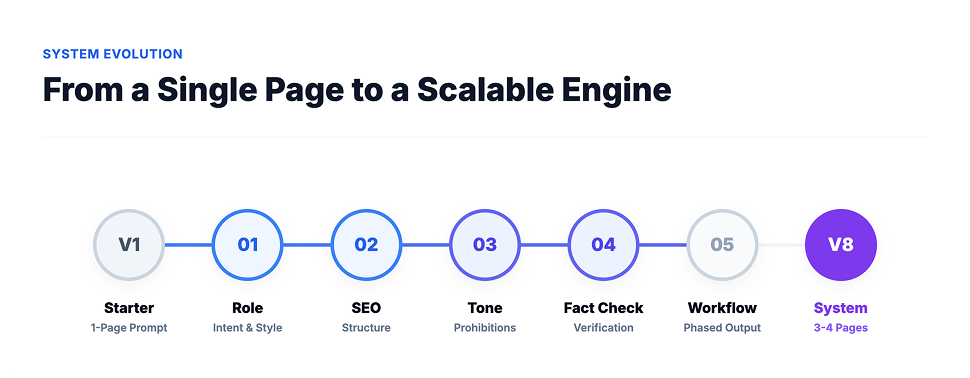
The first version of our master prompt was simple. A role, a brief company description, basic SEO rules. One page of text. It seemed like enough.
The first articles came out fine. Then the editor started sending drafts back with the same notes over and over. “Too corporate.” “No authorial point of view.” “Where’s this fact from?” The prompt didn’t explain how the brand voice sounded, and it didn’t require checking claims before delivering output.
Honestly, this surprised us too. We assumed a good prompt was just a detailed prompt. It turned out the issue was structure, not length.
We added the prohibitions section — the number of stylistic edits dropped immediately.
We added a section on authorial point of view: conclusions and assessments are written from the perspective of the team, not neutrally. “In our experience working across different industries…” instead of “studies show…” — these are different texts in feel.
We added a post-fact-checking protocol: after writing, the AI goes back through all the numbers and claims and compiles an internal summary. At first, it seemed unnecessary — until the very first check caught two incorrect figures in a single article.
We added a three-stage workflow built directly into the prompt: analysis → outline → approval → article. That put a stop to situations where the AI wrote 2,000 words in the wrong direction.
According to Vendasta, iterative prompt improvement is a key principle for achieving consistent quality. Teams that regularly revisit their prompts based on real results avoid quality drift and reduce editing costs.
The current version of our master prompt is the eighth one. And it’s not final either. The master prompt gets updated and expanded over the course of the first 5 articles — not because it was bad, but because new patterns of mistakes show up during the first attempts at writing.
Conclusion
A master prompt isn’t a document written once and used forever. It’s a living system that improves alongside your content.
The correct sequence: gather the data (company, audience, ToV) → build the prohibitions section from real drafts → assemble the five sections into a single document → launch it → iterate.
After reviewing hundreds of client projects, we’ve confirmed: the quality of the master prompt is the strongest predictor of article quality. Stronger than the topic, stronger than the brief, stronger than any other input. Teams that invest time in the prompt get content that doesn’t need to be rewritten.
Sources
TechRT — Generative AI Prompt Engineering Statistics 2026 — https://techrt.com/generative-ai-prompt-engineering-statistics/
The Register — Telling an AI model that it’s an expert makes it worse — https://www.theregister.com/2026/03/24/ai_models_persona_prompting/
Vendasta — AI Prompting: The Complete Guide to Writing Better Prompts in 2025 — https://www.vendasta.com/blog/ai-prompting/
MIT News — Study finds ChatGPT boosts worker productivity for some writing tasks — https://news.mit.edu/2023/study-finds-chatgpt-boosts-worker-productivity-writing-0714
Frequently Asked Questions
About the Authors
This article was written by Neurotool copywriters: a team that has produced 1,000+ articles across 18+ industries since April 2025. Each writer works with our proprietary 15-agent AI system, which handles research and analysis at a scale no manual process can match.
The copywriters make every editorial decision: competitor and audience analysis, structure, SEO + GEO optimization, and final fact-checking. AI speeds up the work; humans control quality at every stage.
Learn more about how our technology works →
Start with One Test Article
A full article, completely free. No card, no contract.
- Ready from 24 hours — fast results
- Live copywriters review every word
- 2-3 revision 2-3 revision rounds included free
- Convenient platform Convenient platform for ordering and communication