
How to Create a Brand Tone of Voice That AI Actually Follows
The most recognizable brands in the world sound the same in every email, post, and article. Not because they have the best writers. Because they have the best instructions.
- Why a list of adjectives is not a Tone of Voice — and what actually is
- How to extract a client's voice when they don't have a single published article
- The one section most ToV documents skip entirely — and why it matters more than anything else
- Why your ToV document needs to be machine-readable, not just human-readable
- The mistake that quietly kills brand voice the moment you start scaling
A Tone of Voice document is a structured guide that captures how a brand communicates: sentence patterns, signature phrases, formality level, and what to avoid. In 2026, with 85% of marketers now using AI writing tools for content production according to WorkfxAI, a ToV document is no longer optional. It’s the only mechanism that keeps a brand’s voice consistent when content is being created simultaneously by multiple writers and AI systems.
Three Adjectives Is Not a Document. It’s a Wish List.
Most marketing teams have some version of a ToV document. It usually looks the same: “professional, friendly, authoritative,” a note about jargon, a couple of example sentences. Then the document gets saved into a shared Google Drive folder that nobody opens.
Sound familiar?
The problem isn’t that teams lack rules. The problem is that the rules are written as wishes, not instructions. Nobody knows how to apply “be professional but approachable” when staring at a blank page at 9 p.m. before a deadline.
According to Envive’s 2026 brand voice study (cited by Column Five in their brand voice guide), 60% of marketing materials fail to comply with brand guidelines — even when those guidelines exist.A real ToV document answers a different question. Not “how should our brand feel,” but “what exactly does our brand say, and exactly how does it say it.” It captures sentence structure. The distinctive way a founder ends a paragraph. The words that should never appear.
The difference is like a mood board versus a technical spec. When you’re producing 20–100 articles a month, you need the technical spec.
Where a Client’s Voice Actually Lives
Before writing the document, you need source material. And here’s what most agencies get wrong: they ask the client to describe their voice. The client says “professional, but not stuffy” — everyone nods. Nothing useful comes out of that conversation.
The voice isn’t in the client’s self-description. It’s in their existing content.
Our onboarding protocol at Neurotool AI starts with a content audit. We look at everything: website copy, existing blog articles, email newsletters, LinkedIn posts — even voice memos, if the client has them. The more varied the material, the more precisely we can extract the patterns.
In practice, two scenarios come up.
Scenario A — the client has existing content. This is the simpler case. The minimum threshold is 4–5 pieces totaling at least 3,000 words. Less than that, and patterns may not hold up — the document ends up guessed rather than extracted. Ideally, 8–10 pieces of different types: an article, a landing page, an email, posts.
From these materials, we extract the underlying patterns: average sentence length, the ratio of short punchy sentences to longer explanatory ones, characteristic connecting phrases, how the client handles technical terms.
Here’s a pattern we see regularly: one client consistently ended communications with the phrase “Good luck! Ciao!” — a signature sign-off that showed up in emails, posts, and comments. A detail like that is invisible on a style questionnaire. It only surfaces when you read enough of what the person actually wrote.
Scenario B — the client is starting from zero. No articles, no blog, maybe just a basic landing page. Here, the process gets more interesting. We ask for references: texts, videos, or writers whose style the client likes. A YouTube channel with the right energy, a book with a tone that resonates, a competitor whose copy the client secretly admires.
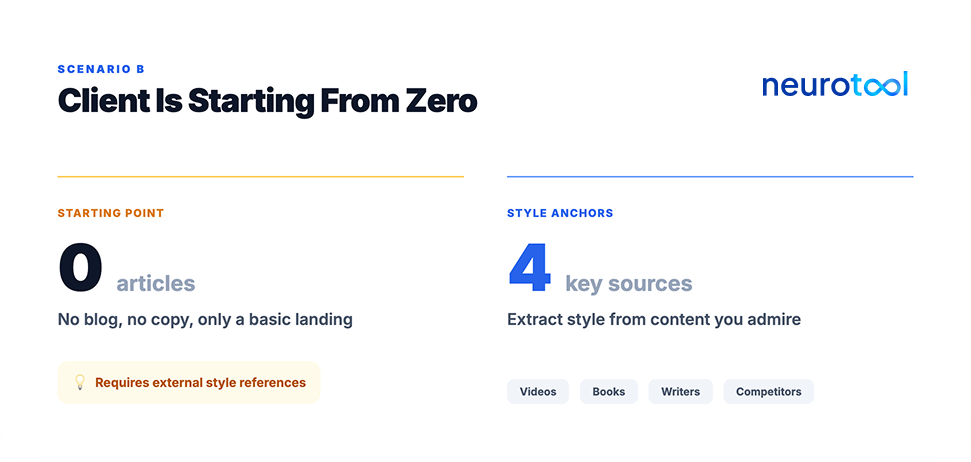
We transcribe a minimum of five videos — not to copy the content, but to extract stylistic patterns. Sentence rhythm. How ideas are introduced. Whether the speaker uses rhetorical questions or a “claim — evidence” structure. These patterns become the foundation of the client’s voice.
The same logic applies to literary references. If a client says “I want something in the style of Hemingway” — that’s not a vague wish. That’s a working brief. Short declarative sentences, minimal adjectives, a direct emotional punch. That translates directly into instructions.
The theory is clear. Now — what exactly goes into the document itself, section by section.
What a ToV Document Actually Contains
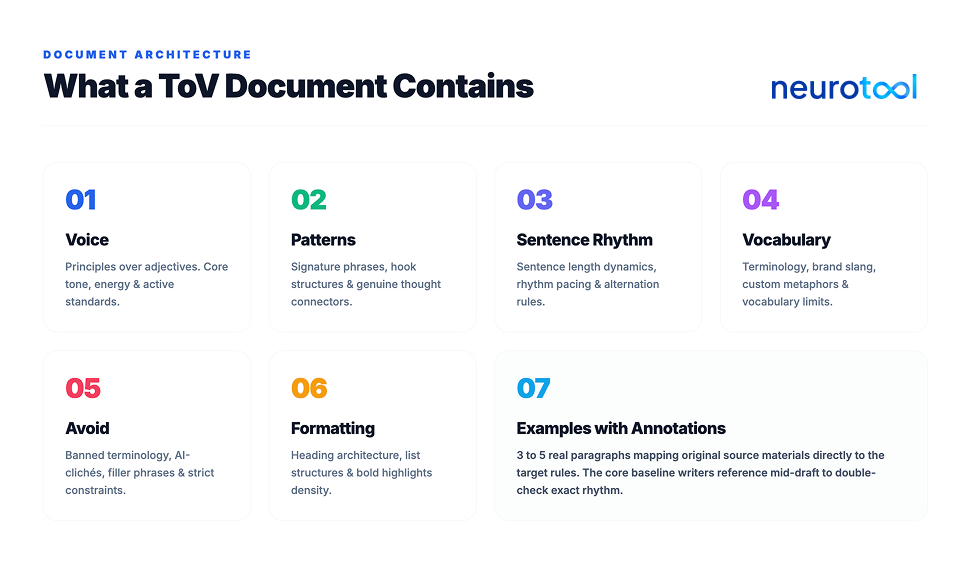
Once the source material is collected, we build a document with seven sections. The structure of the resulting document looks like this:
How we communicate. Not adjectives — principles. “Every paragraph ends with something actionable” is a principle. “Confident” is an adjective.
Here’s what this section looks like in a real ToV document — using our own as an example:
Motivation: 8 out of 10 — every paragraph ends with an action or a number, no filler: “Bottom line: 20 articles a month produce measurable organic traffic growth within 60–90 days.”
Formality: 4 out of 10 — the level of talking to a colleague who knows the subject: “Here’s the thing: topical authority is built over months, not weeks.”
Modesty: 3 out of 10 — facts without bravado: “We process 100+ articles a week” is transparency, not boasting.
Characteristic phrases and patterns. Real examples from the client’s material — how they open a paragraph, what connectors they use between thoughts, whether they ask rhetorical questions or favor statements. This section is filled entirely with real material — nothing invented.
Sentence structure rules. Average sentence length, how short and long sentences alternate, whether one-word sentences appear for emphasis. This is the section most ToV documents skip entirely — and it has the strongest influence on how the final text actually sounds. Two documents with identical principles but different rhythm instructions will produce completely different output.
Vocabulary and terminology. Industry terms the client uses naturally, characteristic metaphors, slang or colloquial language that’s part of the brand.
What to avoid. Banned phrases, AI clichés, filler words, specific constructions that don’t fit the voice. This section is often the most valuable one. Knowing what not to write is faster and more practical than knowing what to write. That’s how the human brain works — and it’s how language models work too.
Formatting rules. How headers are built, how lists are formatted, how and how often bold text is used. These decisions add up across hundreds of articles.
Examples. Three to five real paragraphs from the client’s material with annotations explaining why they work. This is the section writers actually re-read mid-draft when they’re not sure something sounds right.
Below is an example of one of our prompts for creating a ToV document. Use it as a base and adapt it to your own needs.
Prompt: Creating a Tone of Voice Document
How to use it
Attach source materials to the prompt: website copy, articles, landing pages, emails — anything written on the brand’s behalf. The more material, the more precise the result.
Prompt
You are an editor who knows how to read between the lines. Your job is not to invent a brand voice, but to extract it from what has already been written.
Study the attached materials and create a seven-section Tone of Voice document. Every section must be filled with real examples from the texts — not abstractions, not adjectives, not paraphrase. If you find a pattern, show it with a quote. If you don’t find one, write “not present in the materials.”
Section 1 — Voice: how this brand sounds
Describe the voice through behavior, not adjectives. Not “friendly,” but what exactly makes the text friendly: does it address the reader directly, does it use informal or formal address, does it admit mistakes, does it joke.
Specify:
Formality level on a 1–10 scale (1 = conversational, 10 = formal). Support it with a specific example.
3–4 behavioral principles. Format: “[Brand] always / never / often does X.” Each one backed by a quote from the text.
Section 2 — Characteristic constructions
List recurring speech patterns that appear more than once. These aren’t pretty phrases — they’re voice markers that can be reproduced.
Categories:
How they open a paragraph or thought
How they transition between arguments
How they ask the reader questions (or don’t)
How they close a section / call to action
Format: quote → brief comment on what’s working here.
Section 3 — Rhythm and sentence structure
This section is about how the text feels when read aloud. Analyze:
Average sentence length (roughly in words)
Are there deliberately short sentences — and if so, in what context they appear
Rhythm alternation: does a long sentence follow a short one, or is it all roughly the same
Are there single-sentence paragraphs
Provide 2–3 examples with rhythm breakdown.
Section 4 — Vocabulary
List three sets:
Industry terms used without explanation — what the audience is expected to already know
Words and metaphors that recur and appear to be deliberate — brand markers
Everyday comparisons, if any: where something complex is explained through something simple
Section 5 — Prohibitions
The most practical section. Fill it in two parts:
What doesn’t appear in the texts, even though it’s typical for this topic — what words, phrasings, or approaches the brand appears to deliberately avoid.
What appears as a mistake — if there are fragments in the materials that break from the overall voice, flag them. This helps avoid repeating accidental deviations.
Section 6 — Formatting as part of the voice
The visual structure of the text is also a signal. Describe:
How headers are used: do they follow a particular syntax (question / statement / command)
How bold text works: for terms, for emphasis, for key takeaways — or not used at all
Lists: do they appear only for factual enumeration, or anywhere there are more than two items
Paragraph length: is there a limit being followed
Section 7 — Reference excerpts
Choose 4–5 paragraphs from the materials that best capture the brand’s voice. For each, write 2–3 sentences on exactly what’s done right from a voice standpoint. These are reference points — what to aim for when writing new content.
Important
The document must be written so that a writer who has never seen these materials could reproduce the brand’s voice after a single read-through. Abstract characteristics without examples don’t work. Every point must be concrete.
The document is saved to Google Docs and uploaded to the project as a permanent reference. Every article written afterward is created in accordance with it.
What to Do If the Client Has No Content at All
The “no existing content” situation is real. We run into it regularly: a founder has been running a business for years but hasn’t published a single article. The voice clearly exists. It just hasn’t been captured in text yet.
The protocol starts with questions, not writing. We need to understand three things: the formality level the client is genuinely comfortable with (not the one they think sounds professional), the topics on which they naturally express strong opinions, and any communication they’ve already produced — even if it’s just Slack messages or emails to clients.
After that, reference content becomes key. We ask for a few examples of what the client genuinely likes — how they think the brand should sound, and what they actually enjoy reading. The gap between those two answers usually says a lot.
Honestly — it surprises us how often a client names a “desired” style and a “favorite” style, and they’re completely different things. One person wants an “authoritative expert tone,” and their bookmarks are full of casual breakdowns from practitioners. That’s the real reference point.
And here’s another mistake we see constantly: teams skip the ToV step and plan to “figure out the voice as they go.” That produces the opposite result. The first five articles sound like they were written by five different people. Then someone tries to build a ToV document on top of content that already exists — which is significantly harder than building it up front.
Create the document before writing the first word. Even a rough draft is better than none.
Why Your ToV Document Needs to Work for AI, Not Just Humans
Most ToV frameworks written before 2024 completely miss one shift.
According to Wynter’s 2026 B2B Buyer Research, 84% of B2B buyers now use AI tools to research vendors. When someone asks ChatGPT to recommend a content agency, or asks Perplexity to compare options, the AI synthesizes everything it has indexed about each brand. Brands with a consistent, distinctive voice give AI platforms a clear signal. Brands with scattered messaging give them nothing distinctive.
This has direct operational consequences for how we write ToV documents.
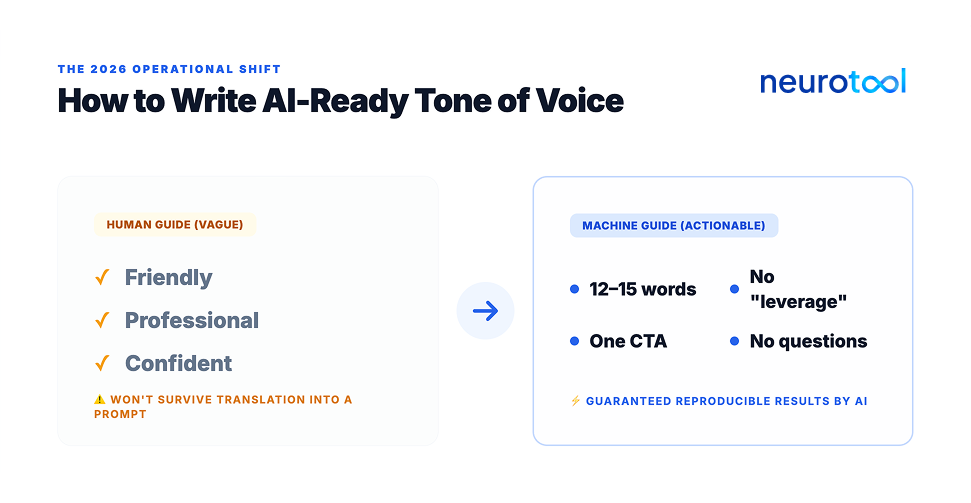
Think of a ToV document not as inspiration, but as an instruction set for a machine. “Be friendly” won’t survive translation into a prompt. “Sentences average 12–15 words, with occasional single-sentence paragraphs for emphasis; no rhetorical questions except to open a section; avoid any form of the words ‘leverage,’ ‘seamless,’ and ‘holistic'” — will survive.
It’s the difference between the instruction “cook something tasty” and a recipe with exact grams and temperatures. One is a wish. The other is a reproducible result.
Based on our experience writing content across 18 industries: moving from a human-readable style guide to a machine-readable instruction set is the single most significant operational improvement a content team can make in 2026. Content comes out more consistent on the first draft. Fewer revision rounds. Faster delivery.
The Mistake That Kills Brand Voice at Scale
You’ve built the document. Now — the most common failure scenario.
Nobody uses it.
CXL’s research describes two types of brands emerging from the AI-content era: those whose voice gets stronger, and those whose voice quietly disappears. The brands losing their voice aren’t the ones without ToV guidelines. They’re the ones whose guidelines exist as documents in folders, rather than as operational constraints inside the workflow.
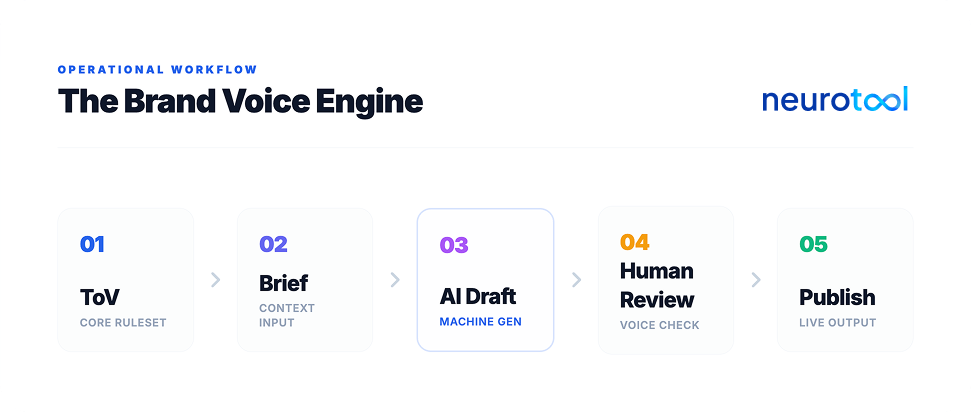
The solution is structural, not motivational. At Neurotool, the ToV document isn’t a reference people check when they’re unsure. It’s a mandatory attachment to every writing workflow. No article begins without it in context. No draft passes review without being checked against the “what to avoid” section. A live editor — a human, not a model — does the final pass, specifically checking for voice drift.
That last point matters more than it seems. AI models produce text that’s internally consistent — but that consistency is not the same as brand consistency. A model without a strong ToV document defaults to a generic, polished, slightly corporate register. It sounds fine. It doesn’t sound like anyone.
We’ve confirmed this across our own client campaigns: ToV document quality is the strongest predictor of article quality. Stronger than topic brief depth, stronger than target word count, stronger than any other input.
Voice Is Infrastructure, Not Decoration
Brand voice is one of the few real differentiators that can’t be directly copied. Competitors can match your pricing, replicate your service structure, and imitate your content strategy. A voice built from years of your actual real communication — they can’t. If you’ve captured it correctly.
The document isn’t the end goal. It’s the infrastructure that lets everything else scale without losing what makes the content yours.
Sources
WorkfxAI — AI Content Tools vs Human Writers: Brand Voice Consistency Comparison 2026 — https://blogs.workfx.ai/2026/03/04/ai-content-tools-vs-human-writers-brand-voice-consistency-comparison-2026/
Envive — 40 Brand Voice Consistency Statistics in eCommerce in 2026 — https://www.envive.ai/post/brand-voice-consistency-statistics-in-ecommerce
Column Five — Brand Voice vs Tone: Why It Matters in the Age of AI — https://www.columnfivemedia.com/brand-voice-vs-tone/
Wynter — How B2B SaaS CMOs Buy Software in 2026 — https://wynter.com/post/how-b2b-saas-cmos-buy-software-in-2026
CXL — How Mindless Use of AI Content Undermines Your Brand Voice — https://cxl.com/blog/ai-content-and-the-silent-erosion-of-brand-voice/
eMarketer — FAQ on B2B Marketing: What’s Shaping Trends, Buyers, and Expectations in 2026 — https://www.emarketer.com/content/faq-on-b2b-marketing–what-s-shaping-trends–buyers–expectations-2026
Frequently Asked Questions
About the Authors
This article was written by Neurotool copywriters: a team that has produced 1,000+ articles across 18+ industries since April 2025. Each writer works with our proprietary 15-agent AI system, which handles research and analysis at a scale no manual process can match.
The copywriters make every editorial decision: competitor and audience analysis, structure, SEO + GEO optimization, and final fact-checking. AI speeds up the work; humans control quality at every stage.
Learn more about how our technology works →
Start with One Test Article
A full article, completely free. No card, no contract.
- Ready from 24 hours — fast results
- Live copywriters review every word
- 2-3 revision 2-3 revision rounds included free
- Convenient platform Convenient platform for ordering and communication