
15 AI Agents Instead of One: How a System That Writes Better Than a Single ChatGPT Is Built
One AI writes fast. Fifteen specialized ones write correctly.
- A single AI agent writing an entire article has to think about keywords, structure, facts, and style all at once — and sacrifices a little of everything
- AI-powered workflows cut time spent on low-value work by 25–40%, according to BCG — but only with the right system architecture
- 86% of marketers still edit AI content by hand, according to GPTZero — because they're using tools without a human-in-the-loop layer
- Specialized agents working together produce content that 65% of companies call better for SEO results than what they had before adopting AI, according to DemandSage
- Verification at every stage of the pipeline dramatically reduces hallucinations — because each stage, preparation, writing, fact-checking, catches a different type of error
A system of specialized AI agents is a production pipeline in which each agent is responsible for one specific task: preparation, writing, or verification. Instead of one AI trying to do everything at once, it’s a chain of specialists, each operating at their maximum in their own zone. The result: content optimized for Google and AI search engines, with human fact-checking at the end.
Why 15 Agents, When ChatGPT Exists
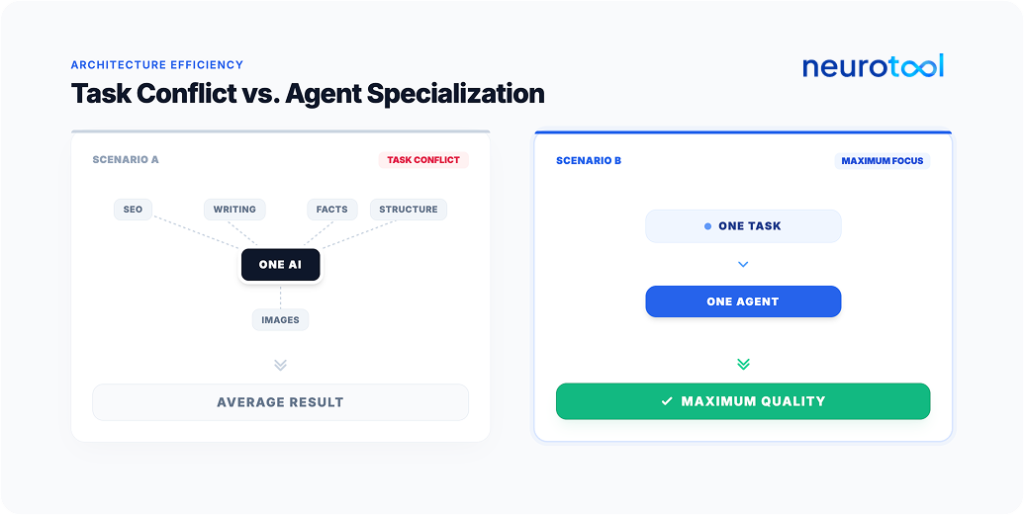
Why build a system of agents, when a single ChatGPT can produce an article in 30 seconds?
The problem isn’t that it writes badly. The problem is that it writes everything at once, and because of that, it doesn’t do any single task truly well.
Imagine asking one person to simultaneously be a data analyst, a content strategist, a copywriter, an SEO specialist, and a proofreader, right now, in one continuous stream, with no pause between tasks. The result will be decent. Not excellent.
Specialization removes this conflict. One agent builds the architecture before the first word is written. Another thinks only about the text. Each one is at its maximum within its own task.
According to BCG, AI-powered workflows with the right architecture cut time spent on routine work by 25–40%. “With the right architecture” is the key part.e” is the key part.
Now, here’s exactly how our pipeline is built on the inside.
Three Stages. Fifteen Agents. One Result.
Our pipeline works on a relay-handoff principle: each next agent receives the output of the previous one as its input. None of them starts blind.
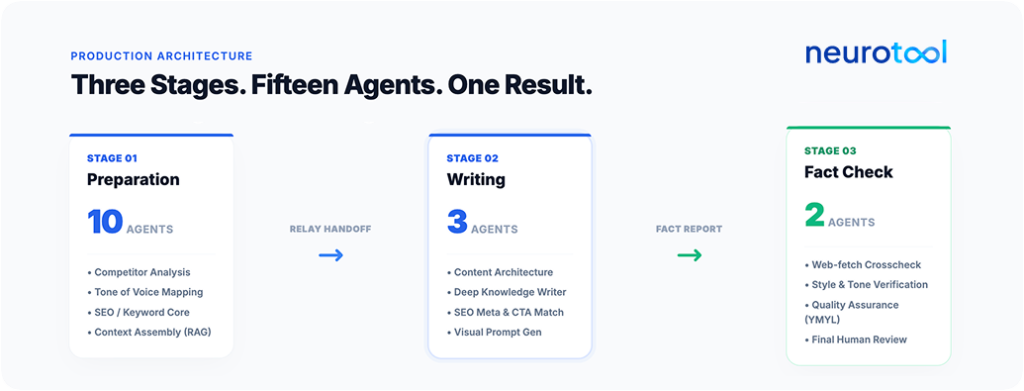
Stage 1 — Preparation
This is the most invisible part of the work. And it’s exactly here that the difference is born between an article “about your niche” and an article “about you.”
The company information agent goes through everything the client has: the landing page, sales materials, regulatory documents, social media posts, existing articles. If there’s a YouTube channel, we transcribe the videos and fold them into the base. From all of this, a document is built containing the USP, products, and positioning.
The competitor analysis agent studies 3–5 players in the niche: landing page copy, positioning, what they promise and what they stay silent on. The goal isn’t to copy them, but to use the contrast to extract the client’s real USP.
The target audience analysis agent builds a buyer portrait: pains, objections, search behavior at every stage of the funnel. This is the foundation for the topics, headlines, and CTAs — everything that needs to land with a specific person, not an abstract reader.
The Tone of Voice agent reads the brand’s voice from the landing page and the client’s existing materials: phrasing, speech patterns, level of expertise, the tone of address. The result is a ToV document used when writing every article.
The personal knowledge base agent structures all the gathered materials into the client’s RAG database. This is exactly where AI pulls facts, examples, and phrasing from when writing every article, not from the global internet, but from the specific company’s own materials.
The competitor article analysis agent, working through the Ahrefs API, looks at which competitor articles are actually generating traffic, which topics are already covered in the niche, and where the unclaimed space is. This eliminates working blind: we see real demand before a single word is written.
The keyword core agent gathers target queries through the Ahrefs API: primary keywords, LSI terms, “People Also Ask” questions, the intent behind every query. Medium-volume queries with real demand and low competition form the foundation of the content plan.
The content plan agent turns the keyword data into technical briefs: meta-title, meta-description, SEO headline, primary keyword, 5–7 secondary keywords, a basic structure for every article. The copywriter or AI receives a finished brief, no guesswork, no extra calls needed.
The master prompt agent pulls everything from the previous stages together into a single prompt for generating articles: company information, SEO and GEO rules, Tone of Voice, audience characteristics. This is the main instrument every subsequent article is written from.
The HTML visuals agent analyzes the client’s website, its color scheme, fonts, style, and creates a prompt for generating infographics for every article. The visuals are built to match the client’s brand identity, not as generic placeholder graphics.
Stage 2 — Writing
Only now does the actual text come in. Three specialized agents, each free of task conflict.
The structure agent builds the article’s architecture: H1, H2, H3. Every heading is a meaningful answer to a specific search query. Right after the H1 comes a quick answer to the main question (40–60 words) — this exact block is what gets picked up by Google AI Overviews, ChatGPT, and Perplexity. FAQ sections and blocks for case studies and testimonials are built into the structure — everything that strengthens E-E-A-T and citability in AI search.
The writing agent works strictly from the approved structure and the client’s personal knowledge base. The text, arguments, examples, narrative, rhythm, and SEO+GEO optimization are all built in from the start: keywords are integrated organically, and neuro-blocks are placed during the writing process itself.
The image generation agent, based on the finished article, generates header images using specialized prompts tailored to the topic and tone of the specific piece.
Stage 3 — Fact-checking
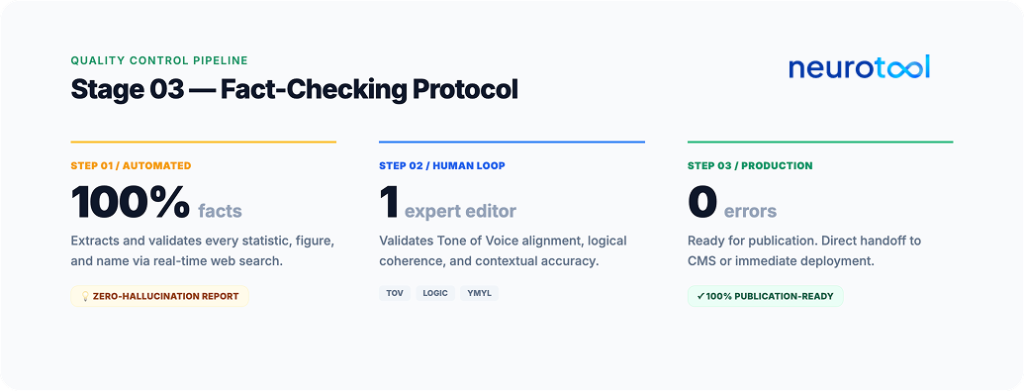
The fact-checking agent goes through the text and extracts every verifiable claim: every figure, every statistic, every study name. It checks each one via web search and web fetch, finds the primary source, opens the page, cross-checks the data. The output is a structured report: what’s confirmed, what couldn’t be found, what was corrected. The article doesn’t move forward until the report says “READY.”
The live editor receives the article together with the fact-check report. Their job is to check what AI can’t: alignment with the brand voice, the logic of the writing for the specific audience, niche-specific nuances. When in doubt, they verify sources themselves. In parallel, technical parameters are checked: uniqueness, character count, keyword stuffing, filler content. Only after passing every parameter does the article go to the client. For YMYL topics, the protocol is expanded: an additional check against industry primary sources and the client’s specialized niche knowledge base.
The fact-checking agent catches hallucinated statistics. The editor catches contextual errors, where a fact is real but applied with the wrong meaning. Different tasks, different blind spots.
What You Get as a Result — and Why It Affects Search Rankings
Three results are obvious: predictable quality at any scale, 24–72 hour turnaround, ready to publish with no revisions needed.
But there’s a fourth one, which most clients notice after a month: citability in ChatGPT, Perplexity, and Google AI Overviews.
The quick answer right after the H1, structured FAQs, verified facts, all of it is built into every article during the writing and verification stages. Not as an option. As part of the standard process.
According to Wellows, real-time fact-checking of content can boost AI Overview selection probability by 89% — making it one of the key filters for citation, not an optional bonus. This is exactly the job of our fact-checking agent at Stage 3: every claim gets verified before the article moves forward. This isn’t hoping for luck. It’s systematic work, built into every single article.
ChatGPT, a Traditional Agency — or a System That Takes the Best of Both
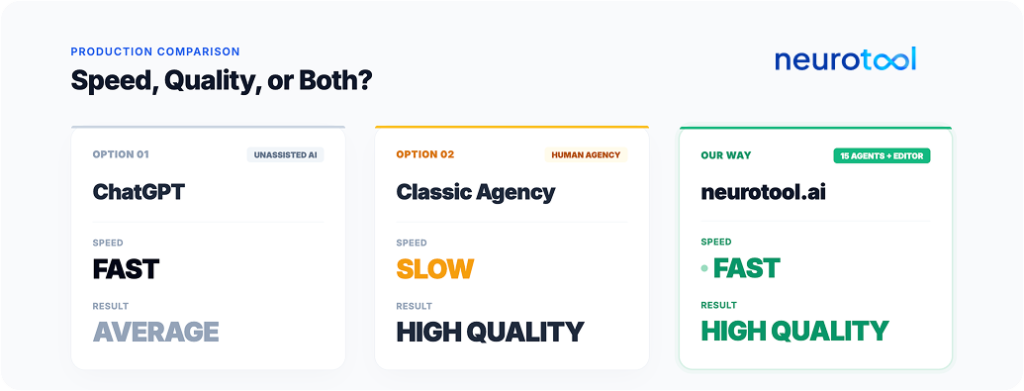
ChatGPT or Gemini can produce an article in 30 seconds. But then comes an hour of manual editing, because the prompt doesn’t know your audience, your voice, or your facts. Fast and cheap, but the result depends entirely on your own time and patience.
A traditional agency delivers quality. A team of copywriters, editors, SEO specialists, each doing their part by hand. Starting at $150 per article, a turnaround of 7–14 days, a retainer for several months.
Our system takes the speed of the first option and the quality of the second. 15 specialized agents do the work of that entire team in a matter of hours, each within their own zone, with no compromises. A live editor checks what AI can’t: context, niche nuances, alignment with the brand voice.
Test the system on one article — your first article is free. Start with your first article →
Sources
Wellows — Google AI Overviews Ranking Factors (February 2026) — https://wellows.com/blog/google-ai-overviews-ranking-factors/
BCG — How Agentic AI Is Transforming Enterprise Platforms — https://www.bcg.com/publications/2025/how-agentic-ai-is-transforming-enterprise-platforms
GPTZero — AI Marketing Statistics 2025 — https://gptzero.me/news/ai-marketing-statistics/
DemandSage — 65 AI SEO Statistics 2026 — https://www.demandsage.com/ai-seo-statistics/
FAQ
About the Authors
This article was written by Neurotool copywriters: a team that has produced 1,000+ articles across 18+ industries since April 2025. Each writer works with our proprietary 15-agent AI system, which handles research and analysis at a scale no manual process can match.
The copywriters make every editorial decision: competitor and audience analysis, structure, SEO + GEO optimization, and final fact-checking. AI speeds up the work; humans control quality at every stage.
Learn more about how our technology works →
Start with One Test Article
A full article, completely free. No card, no contract.
- Ready from 24 hours — fast results
- Live copywriters review every word
- 2-3 revision 2-3 revision rounds included free
- Convenient platform Convenient platform for ordering and communication